What does the Strata engine run, and on what hardware?
Strata is a free, MIT-licensed engine that runs Qwen3.8-Flash-Next, Qwen3.6-35B-A3B and DeepSeek V4.1 Flash 1017 on consumer hardware: NVIDIA RTX 20 to 50, AMD Radeon, Intel Arc on Linux (Qwen models), Apple Silicon, Ryzen AI Max and the DGX Spark. What does not fit in memory is read from your SSD, which is how a 12 GB card reaches a model of 748 billion parameters. It is also the catch, and it sits in your RAM and your disk, not in your graphics card.
This page covers the engine at version 0.2.10, published on 2 November 2026. Our Strata calculator reads 0.2.10 too: the pack sizes did not change, and the DeepSeek view now carries the ISTA-DAS Coder. Strata works with Claude Code, Codex CLI and OpenCode through OpenAI- and Anthropic-compatible APIs. The older Qwen3.8 Flash Next page keeps the story of the 12 GB card and our own measured runs.
| Family | What Strata offers | Where it runs |
|---|---|---|
| Qwen3.8-Flash-Next | ISTA-DASLab Q2_0, IQ2_XS, IQ3_XXS, IQ3_S (IQ1_M for coding); Unsloth UD-IQ4_XS up to Q8_0; Gyro-S and Gyro-M | Every platform in the hardware list |
| Qwen3.6-35B-A3B | Unsloth UD-Q4_K_XL, UD-Q6_K_XL, Q8_0 | Same |
| DeepSeek V4.1 Flash 1017 | ISTA-DASLab IQ1_M, IQ2_XXS, IQ2_XS; Unsloth UD-IQ1_S, UD-IQ1_M, UD-Q8_K_XL; the ISTA-DAS Coder since 0.2.10 | RTX 30, 40 and 50, Radeon AI PRO R9700 on Linux, Strix Halo on Windows, Macs with 64 GB or more (pictures since 0.2.10) |
Source: Strata's README and docs, version 0.2.10, plus the 0.2.10 release for the ISTA-DAS Coder.
The catch: RAM and disk, not the card
Strata's DeepSeek sets are 239 to 274 GB to download, and its README asks for about 245 to 280 GB of free disk. Most of that is not the model you chat with. Every set carries the same 111 GB Engram lookup table and an 8 GB drafter. DeepSeek V4.1 Flash keeps a 203 GB n-gram table next to its 384 experts per layer, and Strata reads a few rows of it for each word, from the SSD. The table never counts against your RAM.
What counts against your RAM is the experts the card cannot hold. Strata sizes each set for a RAM class:
| Set | Download | Free disk | RAM Strata sizes it for |
|---|---|---|---|
| ISTA-DASLab IQ1_M (1.75 bpw) | 239 GB | about 245 GB | 34 GB |
| Unsloth UD-IQ1_S | 241 GB | not stated | 36 GB |
| ISTA-DASLab IQ2_XXS (2.00 bpw), Strata's pick | 257 GB | about 265 GB | 40 GB |
| Unsloth UD-IQ1_M | 258 GB | not stated | 40 GB |
| ISTA-DASLab IQ2_XS (2.25 bpw) | 274 GB | about 280 GB | 44 GB |
| Unsloth UD-Q8_K_XL | 516 GB | not stated | 306 GB |
Sources: Strata's README and DeepSeek guide at v0.2.9; RAM classes from setup.py at v0.2.9, as our calculator carries them.
Below its RAM class a set still starts. Strata's guide says part of the experts are then read from the SSD while the model answers: "It runs, slowly." If you already have ISTA's Engram file, Strata's notes say the Unsloth downloads shrink by about 111 GB, because the two families share it.
Strata 8 GB VRAM: What the Card Holds, and What the PC Still Needs
Strata 0.2.10 runs Qwen3.8-Flash-Next at its default 128K context on an 8 GB discrete card, and "Strata 8 GB VRAM" is a question about two budgets, not one. The card holds the experts it can and the rest come from system RAM and the SSD. An 8 GB card changes where the model sits; it does not lower the RAM the model needs.
The release keeps three results apart, and they should not be mixed:
- A real Intel Arc A750, 8 GB: all four 128K starts they tried started at the asked context and request count, at 12.7 to 14.8 tok/s. With the drafting setting on Auto it ran DFlash2 alone at 13.9 to 18.4 tok/s.
- A larger card limited by hand to about 8 GB, on a workstation with a lot of RAM: 63 to 73 tok/s for DFlash2 alone, 61 to 71 with MTP asked for, and a 32K prompt read in 19.8 s or 13.4 s. The release does not name the card, so this is not a real 8 GB GPU.
- A real RTX 5070, 12 GB, limited to about 8 GB: the 128K start kept its context and ran 17 to 27% slower than on the full card.
The RAM side is the part that decides whether it is usable. At 128K with IQ3_S, the set the 0.2.10 test used, you need about 50 GB of experts plus about 6 GB of working set, which is a 64 GB machine. The smallest standard set, Q2_0, is about 34 GB plus 6 GB, so 48 GB is the practical floor and 64 GB is comfortable. The 28.8 GB n-gram table stays on the SSD and is not counted in either figure. A 32 GB machine should look at the Coder instead, at about 23 GB of experts.
An 8 GB card is not the DeepSeek configuration. Strata's DeepSeek release asks for a card of 12 GB or more; the 8 GB change in 0.2.10 is about Qwen3.8 Flash Next. For DeepSeek, use the RAM classes in the table above and size the largest card you have. @coldniko's launch post says "20+ tokens/second" on an 8 GB card; the measured real 8 GB card is the Arc A750 at 13.9 to 18.4, and the 60s are the larger card limited by hand.
What will your PC run?
Here is what our Strata calculator says for the 2.00-bit set Strata picks by default, at 64K of context on Windows:
| Machine | Verdict |
|---|---|
| RTX 3060 12 GB, 32 GB RAM | Slow: too little RAM. Strata sizes it for 40 GB |
| RTX 3060 12 GB, 64 GB RAM | Runs, part from the SSD |
| RTX 4090 24 GB, 64 GB RAM | Runs, part from the SSD |
| RTX 4090 24 GB, 128 GB RAM | Runs, all in RAM |
Source: the live Strata calculator, 31 October 2026.
Read it down the middle. Doubling the card from 12 to 24 GB does not change the verdict at 64 GB of RAM. Doubling the RAM does. On the RTX 4090 with 128 GB, the 1.75-bit set and both Unsloth 1-bit sets also run all in RAM; only UD-Q8_K_XL asks for more, 306 GB.
Strata can tell you the same thing: strata launch --plan and setup.py --check work out the split for your cards and RAM, and the sizes are given before anything is downloaded. That still means installing Strata first. Our Strata calculator gives the answer in a browser, for all six DeepSeek sets side by side, before you install anything.
How fast is Strata on a normal PC?
Strata publishes a speed table for the 2.00-bit set. These are its own measurements, not ours, and most were taken on version 0.2.5.
| Hardware | Answer speed | Prompt speed |
|---|---|---|
| RTX 5070 12 GB, 64 GB RAM | 4 to 6 tokens/s | about 110 tokens/s (4K) |
| RTX 3060 12 GB, 46 GB RAM | 9 to 11 tokens/s | about 155 tokens/s (4K) |
| 1 Radeon AI PRO R9700, 251 GB RAM | 21 to 25 tokens/s | 320 to 360 tokens/s (8K) |
| 4 Radeon AI PRO R9700 | 74 to 77 tokens/s | 400 to 450 tokens/s (8K) |
| Ryzen AI Max+ 395, 128 GB unified | 19 to 21 tokens/s (code), 11 (chat) | 87 tokens/s (4K), 125 (8K) |
Source: Strata README. The Strix Halo row is version 0.2.7.
Start with the two 12 GB cards. The older RTX 3060 with 46 GB of RAM out-runs the newer RTX 5070 with 64 GB, and Strata does not explain the gap, so match your own card and RAM against both rows instead of assuming the newer card wins.
Which DeepSeek set should you pick?
Strata's setup recommends the 2.00-bit set from 40 GB of RAM and drops to the 1.75-bit set where RAM or disk is tight. Since 0.2.9, Unsloth's UD-IQ1_S and UD-IQ1_M are a choice too, in setup and in strata launch. Strata measured both beside ISTA's 2.25-bit set, with Unsloth's Q8_K_XL file as the reference, over 4,995 positions:
| UD-IQ1_S | UD-IQ1_M | ISTA-DAS 2.25 | |
|---|---|---|---|
| KL against the reference | 0.114 | 0.087 | 0.110 |
| Top-1 agreement | 87.2% | 88.8% | 87.4% |
| Perplexity against the reference | +4.8% | +3.0% | +8.9% |
| 61-task suite | 53 | 53 | 56 |
Source: Strata 0.2.9 release notes, Strata's own tests.
The measures disagree, and that is the useful part. On the distribution measures UD-IQ1_M is the closest to the reference. On the task suite, ISTA's 2.25-bit set solved 56 of 61 and both Unsloth sets 53. Strata calls these single runs on its own test texts, so treat the gap as a reason to try both on your own work, not as a ranking.
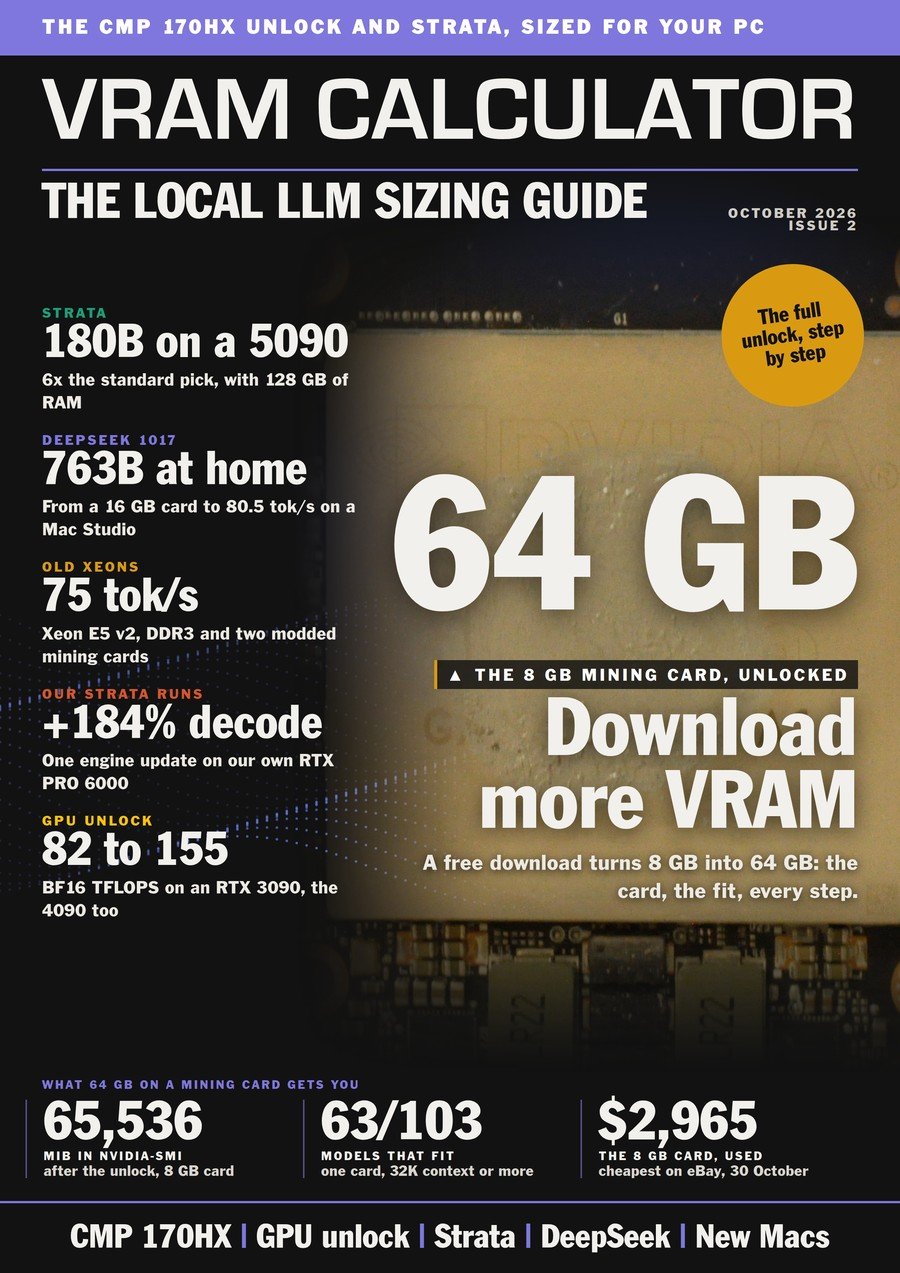
The Local LLM Sizing Guide. Issue 2, 31 October
The calculator answers one machine. Issue 2 answers every card at every RAM size.
Strata’s pick for every card and every RAM size, PC and Mac, and every cell of our own Strata runs on an RTX PRO 6000: decode, prefill, first token and peak memory.
$24.90 for three issues, or $9 a month. Card or crypto.
Strata or Project Maya?
Both run DeepSeek V4.1 Flash 1017: 748 billion parameters by Maya's count, 763.2 billion by tensor count on our model page. They are related. Strata's DeepSeek engine, strata-dsv41, is ported from Project Maya's maya-ds4 at Maya release 1.1.17, and the notice in Strata's repository adds that "Project Maya is itself built on Strata." Pick by your machine and your model:
- A Mac: Strata. It runs DeepSeek on Apple Silicon Macs with 64 GB or more, text only. Maya's Mac support covers GLM-5.3-Flash only.
- Qwen3.8-Flash-Next or Qwen3.6-35B-A3B: Strata, which is built around them, including Intel Arc on Linux.
- GLM-5.3-Flash or MiniMax-M3.1-Flash: Project Maya. Strata does not run them.
- Intel Arc for DeepSeek: neither engine.
For DeepSeek on an NVIDIA or AMD PC, both work, with different menus. Size your machine in the Strata calculator and the Maya calculator before choosing, and see our Project Maya article for its builds. Resident sizing for the full 510.3 GB original is on the VRAM requirements page.
What changed in Strata 0.2.8 to 0.2.10?
Strata ships fast: 0.2.4 on 24 October, 0.2.9 on 31 October, 0.2.10 on 2 November. These are the changes that move a sizing or a buying decision, from the release notes.
- Several AMD cards, 0.2.9. Four Radeon AI PRO R9700 cards used to run DeepSeek on one card with 2,371 of 15,360 experts resident. They now fill all four with 12,147 of 15,360, and decode went from 7.8 and 25.7 to between 57.7 and 103.7 on six answers.
- Strix Halo on Windows, 0.2.9. On the DeepSeek 2.25 set a 4K prompt reads at 183.7 tokens/s against 148.8, and a 16K prompt at 469.9 against 298.0. With Qwen3.8 IQ3_S an 8K prompt goes from 791 to 1,424.
- DGX Spark, 0.2.9. DeepSeek 2.25 reads a 1,953-token prompt at 208 tokens/s against 144. Decode is the same within noise.
- Linux NVIDIA, 0.2.9. Eight parallel requests run 1.45 times as fast as in 0.2.8.
- Mac, 0.2.8. DeepSeek on an M5 Max with 128 GB no longer slows after a few requests: a leak of about 1.3 GB per request had dragged decode from 16 tokens/s to 3. It now holds 18 to 22. Strata did not test a 256 GB Mac Studio.
- Intel Arc B-series, 0.2.8 and 0.2.9. Two Arc Pro B65 cards decode Qwen3.8-Flash-Next 17% to 23% faster in 0.2.8, and read prompts 4.6% to 15.8% faster in 0.2.9. It applies to exactly two B-series cards.
- 12 GB NVIDIA cards, 0.2.8. The 0.2.7 routing speed-up is off again by default, after reports tied it to repeated text in long sessions. It had raised RTX 3060 code speed by 37%.
- 8 GB cards and DFlash2, 0.2.10. Qwen3.8 Flash Next starts at 128K on 8 GB discrete cards, and DFlash2 becomes the default drafter at about 0.7 GB instead of the 5.2 GB MTP layer. Against MTP it is +12.0% on short and +8.8% on long answers on Strix Halo, +7.88% greedy on an RTX PRO 5000, +6.6% on an R9700, +5.8% on a DGX Spark and +7.4% on an M5 Max, and 2.6% slower on the Arc A750. It answers one request at a time; Auto picks MTP at two or more.
- The all-cards split engine, 0.2.10. On Linux,
strata launchnow splits every layer across two NVIDIA cards of compute capability 8.6 or 12.0, or four R9700. On two A6000 at 128K, code edits ran at 377 to 394 tok/s against 195 and prose 139 to 146 against 93; the cost is a 32K prompt read in 10.1 to 10.2 s against 7.65 to 7.81 s. On four R9700 it gave 158 tok/s for one user and 350 at eight, against 98 and 243. - The ISTA-DAS Coder, 0.2.10. A coding version of DeepSeek that keeps 192 of 384 experts. A fresh install is 191 GB: 72.1 GB model, the shared 110.6 GB Engram and an 8.0 GB drafter. Decode 59.2 tok/s on four R9700, 22.8 on one, 20.9 to 21.9 on Strix Halo, 19.1 to 22.5 on an M5 Max, about 100 on an RTX PRO 6000. Quality is KL 0.397 against the original, where the 2.00 set is 0.171 and the 2.25 set 0.109.
- DeepSeek pictures on a Mac, 0.2.10. 8 of 8 picture requests read correctly on an M5 Max; decode 19 to 22 tok/s with pictures against 21 to 22 for text, and the engine's peak stayed at 74.0 GB.
- The 0.1.55 cache reports, 0.2.10. #4733 is fixed: a Windows engine started from a low-priority program inherited Low disk priority and lost about 14% decode; it now resets to Normal. #4841 is still open at 25 comments, the 3090 that went from about 80 to 60 tok/s with 4,445 experts (13.0 GB) in VRAM against 5,413 (15.8 GB) on 0.1.52. Against that, @lyesbahi's paired 0.1.55 to 0.1.56 tables show 152.4 to 227.1 tok/s chat decode on one RTX 5090 and 41.1-41.5 to 50.7-54.6 text copying on 2x Tesla P40, with the P40 run carrying a long-lookup-window patch.
FAQ
What is the Strata engine?
An open-source, MIT-licensed local inference engine by Niko1221. It runs Qwen3.8-Flash-Next, Qwen3.6-35B-A3B and DeepSeek V4.1 Flash 1017 on NVIDIA, AMD, Apple Silicon, Strix Halo and the DGX Spark (Intel Arc for the Qwen models only), with a desktop app and a Terminal.
How much disk and RAM does Strata need for DeepSeek?
The ISTA sets download 239, 257 and 274 GB and want about 245, 265 and 280 GB free. Strata sizes RAM at 34 GB for the 1.75-bit set, 40 GB for the 2.00-bit set it recommends and 44 GB for 2.25-bit. With less RAM it still runs, more slowly, reading part of the experts from the SSD.
Can Strata run DeepSeek on a 12 GB card?
Yes, with offloading. Strata's tables show 4 to 6 tokens/s on an RTX 5070 with 64 GB of RAM and 9 to 11 on an RTX 3060 with 46 GB, on the 2.00-bit set. Those are Strata's measurements on version 0.2.5. Our calculator rates an RTX 3060 with 32 GB of RAM as too little RAM for that set.
Does Strata run on an 8 GB card?
Yes, for Qwen3.8 Flash Next at 128K context, since 0.2.10, on discrete cards. A real Intel Arc A750 8 GB starts at 13.9 to 18.4 tok/s on Auto with DFlash2, and 12.7 to 14.8 on the four 128K tests. The RAM is the real limit: at 128K with IQ3_S you need about 50 GB of experts plus 6 GB, so 64 GB of RAM; Q2_0 needs about 34 plus 6, so 48 GB. Strata's DeepSeek release asks for a 12 GB card, so an 8 GB card is a Qwen configuration, not a DeepSeek one.
What is new in Strata 0.2.10?
Released on 2 November 2026, with app and Terminal 0.2.10 and Control and engines 0.1.56: 128K context on 8 GB discrete cards, DFlash2 as the default Qwen3.8 drafter, an all-cards split engine on Linux, the ISTA-DAS Coder for DeepSeek V4.1 Flash, and DeepSeek pictures on a Mac. It also fixes the Windows low disk-priority inheritance (#4733) that cost about 14% decode. The 3090 expert-cache report (#4841) is still open.
Which Strata DeepSeek set should I pick?
Strata recommends the 2.00-bit set from 40 GB of RAM and the 1.75-bit set where memory or disk is tight. Unsloth's UD-IQ1_M scored closest to the reference in Strata's own test, and ISTA's 2.25-bit set scored highest on its task suite.
Does Strata run on a Mac?
Yes. DeepSeek runs on Apple Silicon Macs with 64 GB or more, text only, and Strata recommends 64 GB or more for it.
Should I use Strata or Project Maya?
On a Mac, or for the Qwen models, Strata. For GLM-5.3-Flash or MiniMax-M3.1-Flash, Project Maya. For DeepSeek on an NVIDIA or AMD PC, both run it; compare your machine in both calculators first.