Strata calculator
Strata Calculator: Can Your PC Run It?
Minimum: our estimate of the least card and RAM that run this quant at this context. Recommended: Strata's own pick, from its README and installer. Estimates; no speed is implied.
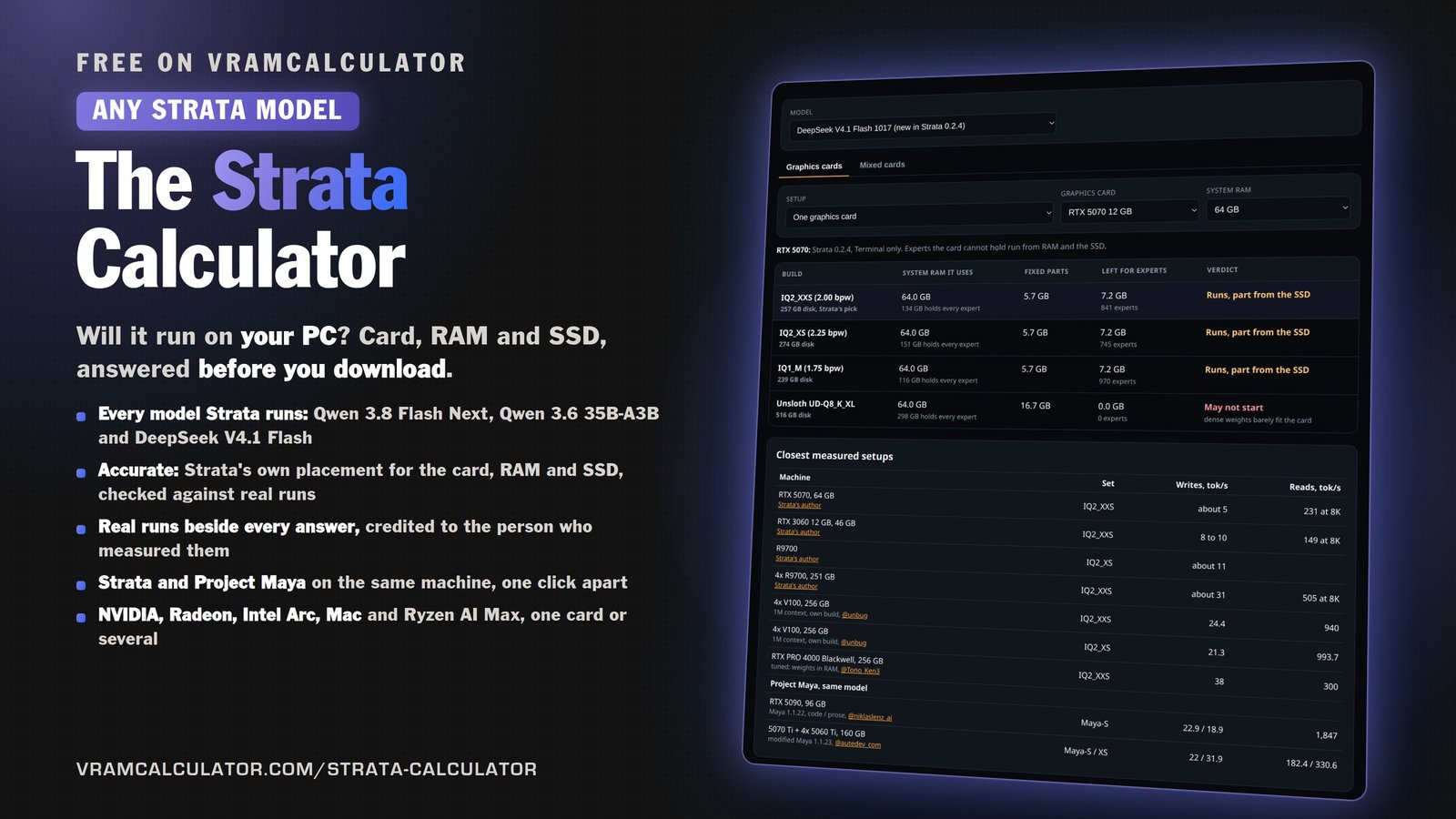
| Build | System RAM it uses | Fixed parts | Left for experts | Verdict |
|---|
Model and file sizes are decimal GB. A card's label is read as GiB, so a 12 GB card is 12.9 decimal GB of memory.
Running a model fully in memory with llama.cpp, MLX or LM Studio instead? The Mac Checker sizes every model in our catalogue for your Mac.
New to Strata? The engine guide covers the download arithmetic, every build and the 0.2.11 changes.
Closest measured setups
How this is calculated (1.0)
This is version 1.1. It covers Macs (Strata's Metal engine, new and experimental in Strata 0.1.44, which runs Gyro from 0.2.2), unified memory (a machine whose GPU and CPU share one pool: an NVIDIA DGX Spark, and the AMD Ryzen AI Max family), mixed cards (a layer split across cards of different sizes or generations, or an expert peer that holds only experts) and Strata 0.2.2's Main / Helper / Off role for every card.
It tracks Strata 0.2.20 (engines and Control 0.1.66, read 2026-11-23). 0.2.18 added Tencent Hy4-Flash and 0.2.19 Inkling 2 Mini, each on its own engine; 0.2.20 adds 10 Unsloth GGUF builds to Inkling 2 Mini beside its three packs, automatic host KV offload (--kv-offload auto on CUDA cards up to 13 GB), Vt-free MLA and a 4 GB floor on Hy4-Flash, and multi-GPU layer split across up to 4 cards on both families. Their builds and where the parts go come from Strata's own fit rules (hy4_fit.py, inkling_fit.py), checked against them on 7,256 machines. For Qwen, 0.2.18 and 0.2.19 change speed only; 0.2.20 lowers the Unsloth budget-build KV streaming floor to 16 GB RAM (max(16, 10 + kv + 4)) and starts KV streaming at 32K on cards up to 16.5 GB, defaults to int8 KV on cards up to 12.5 GB (every build) and 16.5 GB (Unsloth), lowers the discrete card floor to 3.5 GB (admitting 4 GB cards), and adds a 0-slot expert cache mode on 4 and 6 GB cards when dense weights and KV fit without the drafter. 0.2.17 leaves 17 GB of RAM beside the Unsloth builds' RAM budget on one card, not 24 (a 64 GB PC keeps 47 GB of experts in RAM, not 40); a layer split and a PC whose GPU shares its memory keep 24, and so does the app's "Leave 20% for my work". the ladder is 22 builds, its figures re-read at setup.py, its memory tiers and the README sizes table and found identical to the 0.2.0-beta stamp. The releases between our last read and this one moved the placement arithmetic in ways this page now reads. 0.2.13 kept every fit file byte-identical and moved DFlash2's verify windows and the Metal F16 default into the engine. 0.2.14 made each card of a layer split keep only its own layers' dense weights (below), moved the drafter head into the last stage's room before the cache is sized (our 1,000 MiB drafter term on a split already covered it, a little conservatively), let the NVIDIA picture reader hold no room back before the first picture (below), dropped DeepSeek V4.1 Flash (below), and turned prompt reading onto its own kernels: speed only, the placement figures unchanged. 0.2.15 is app and Control work: the app no longer starts an external llama-server, and the DeepSeek refusal moved to the Control level. 0.2.16 runs the engines on Strata's own code (no ggml or llama.cpp matrix kernels); the single-request placement code (the expert cache, the reserves, the split, the unified cache) is unchanged, so only the Mac rule and the RX 6000 note move (below). The card roles are Strata's own rule (strata_control/gpu_roles.py): the best card starts as Main, the others as Helpers, and a card of 8 GB or less starts Off when a bigger card is there (since 0.2.3, two 8 GB cards are both used; 0.2.14 adds a tie-break: a faster card with less memory than the card the list ends on keeps the list's order). Main runs the last stage: the output head, the draft layer and the final check of every window. The engine takes the cards in stage order, so Main is last, and the draft layer is charged to Main here. When two cards are the same model and size, Strata puts the higher card number on Main. Strata picks Main by SMs times max clock, which no catalogue row carries, so this page uses the same fallback Strata uses when speeds are unknown: the card with the most memory, and the higher number for identical cards. A role can be changed in the app and in strata launch --gpu-roles.
On one discrete card the drafter is DFlash2 by default since 0.2.15 (strata_control/drafting.py: Auto picks it wherever the engine has it), and the engine prices it itself: about 1.2 GiB of VRAM in all (the pack 0.76 GiB, its buffers and K/V ring 0.25 GiB, a draft head 0.2 GiB). We charge the 0.2 GiB over the old 1 GiB draft layer the same way we charge the picture reader. Where Auto keeps the MTP we charge nothing: the R9700 and RX 9070 class (a DFlash2 prompt stall is open there), and IQ3_S on an NVIDIA card of the 12 GB class, where Strata measured the MTP faster. On a Mac the drafter is the Mac engine's own choice and nothing is charged. A layer split keeps the 1,000 MiB term it always had.
On a card of 9.5 GB or less our floor now reads Strata's own tight-card terms instead of the big-card allowance: the engine settles on a 300 MiB reserve when the default leaves too few expert slots (a 6 GB card starts this way, #496) and its runtime's own context is about 250 MiB, so a start we used to refuse can answer as it really starts, with a few hundred expert slots. Measured on exactly that corner: DmNep's GTX 1070 8 GB ran Unsloth UD-IQ4_XS at 32K with 389 of 24,576 experts in the GPU cache, where our old floor said it does not start. Cards that already started keep their answers unchanged. Where the default still does not fit, the engine has one more start in it that its own setup would not pick: a 4-bit KV cache with an explicit 20,480-position resident window (--kv q4_0 --kv-resident 20480, half of int8's memory). The card says so instead of a flat refusal: @uctive's RTX 3050 8 GB at 256K runs that way with 498 expert slots.
Gyro runs on Intel Arc since 0.2.2 (tested on an A750 only) and on Apple Silicon Macs. On a Mac it is never the default: Gyro-S is 58.5 GB on disk and its weights need about 38 GB to stay in memory, so a 48 GB Mac holds it and a 32 GB Mac streams the experts (measured on a 32 GB M4: 9.1 tokens a second, 109 reading a 4K prompt). Gyro-M needs about 71 GB, so a 96 GB Mac holds it; it has not been measured on a Mac.
Strata 0.2.2 also shrinks a start that is a little too big instead of refusing it: on an Intel Arc, setup and strata launch try a 32K, 16K and 8K context, a 1024-token prompt chunk and a 100 MiB reserve, in that order, and keep anything the person chose. Where that applies, the verdict says which settings the check would pick, from the same arithmetic (strata_control/vram_fit.py). The app's own fit check is unchanged, and the NVIDIA and AMD paths do not run it.
Pictures are on by default. On one discrete AMD card of 24 GB or more the GPU reader sits inside one 2,048 MiB reserve Strata keeps on the card, so we charge the difference from the usual reserve (1,348 MiB; nothing on AMD Windows, whose own reserve is larger); under 24 GB the reader runs on the CPU and takes nothing. Checked against @TheTokenVoyager's R9700 run (Windows, 256K, IQ3_S): 10,147 experts measured, 10,146 calculated. Since 0.2.15 the same reader on one NVIDIA card is loaded on demand and holds nothing back before the first picture: the expert cache gives the reader its room while a picture is read and takes it back after, so nothing is charged and the Pictures control disappears (Strata measured an RTX A6000 at the same 13,526 slots before any picture as with the reader on the CPU). A Mac always gets the GPU reader whatever its memory, and its footprint (about 1.2 GB, mostly the 0.9 GB projector) sits inside the buffers already counted for the Mac. An Intel Arc gets the CPU reader, so nothing is charged there either. Splits, unified devices and the Qwen3.6 path are not charged: those paths have no measured figure yet.
On a Mac we apply Strata's own Mac rule (strata_control/mac_fit.py at 0.2.16). A resident IQ3_S or Q2_0 pack runs --spec 3 --spec-min-p 0.5 with Metal F16 by default (0.2.13 moved the F16 switch into the engine); neither changes the memory verdict. A pack stays in memory when the file the GPU maps and 12 GiB beside it fit: three quarters of the memory, less what macOS keeps (7 GB or 15%, and 30% on a Mac with 64 GB or more). 0.2.16 took both from the engine itself, so a pack setup used to keep resident now streams on some Macs (Q2_0 on 64 GB), as the engine already did. Otherwise the experts stream from the SSD, and the engine keeps the most-used ones in an arena by its own arithmetic. The default pack and context are Strata's: IQ3_S where it stays in memory, else IQ3_XXS, else Q2_0, at 32K below 96 GB and 64K from 96 GB. Strata offers every v3.1 pack on a Mac; none has been run on a Mac yet, and the default pack stays IQ3_S. 0.2.12 makes DFlash2 the Mac's default drafter for UD-Q4_K_XL and UD-IQ4_XS-v31 (IQ3_S keeps MTP); the memory verdict does not change. Below 16 GB Strata's app says no model fits.
Discrete cards and several of the same card keep the engine that always computed them, with one 0.2.14 reading on top: each card of a layer split now loads only its own layers' dense weights by default, so the caches gain what the dense copies gave up (STRATA_STAGE_TRIM=0 restores a full dense copy on every card; we model the default and keep the old way at the pre-0.2.14 stamps). A mixed pair uses Strata's documented placement, each card keeping its own layers' dense weights and its own KV share, with the expert caches adding up. An expert peer is Strata's peer tier instead: card 1 runs every layer, and the peer only adds expert cache.
On a Linux AMD APU (Strix Halo, Gorgon Halo) the GPU expert cache is Strata's own number, not "auto": the engine sizes it from the smaller of what the GPU says is free and what the OS says is available, less a reserve for the desktop (the larger of 8 GiB and 8% of the RAM), then its 700 MiB reserve, a 380 MiB draft head and 256 MiB of after-cache room come off. Measured on @BrofessorSpez's 128 GB Strix Halo at 0.2.15, 18 Nov: every IQ3_S expert cached at 128K and 256K; UD-IQ4_XS-v31 18,285 of 24,576 experts (74%) at 128K and 17,503 (71%) at 256K, our figures within 1%. On Windows the same view keeps the pool answer and says the cache is auto: no Windows startup log exists, and the engine compiles the desktop reserve out there. The same rule ends the old contradiction on a 64 GB box, where the plan used to say the experts stream from the SSD while the GPU held all of them: on Linux the cache now shares the one RAM with the arena, and a 64 GB box holds only a few per cent of the experts; no 64 GB run exists yet, so treat those cells as estimates.
System RAM follows Strata's rule (docs/MODELS.md): the experts plus about 10 GB for the system and other programs. The RAM column always includes those 10 GB, and in low-RAM mode it drops the experts the cards already hold. Strata's suggested size counts RAM and VRAM together less the 5 GB the system keeps (0.2.2, #3425). AMD's RX 6000 series has its own engine package since 0.2.2, built and not run on a real RX 6000 card.
DeepSeek V4.1 Flash 1017 is the one model this page offers that Strata no longer runs: version 0.2.13 was the last one that set it up and started it, and 0.2.14 refuses a saved DeepSeek config before anything starts, leaving the files untouched. Niko says the removal is temporary, so the family is hidden from the model menu rather than deleted: its view, engine and data all stay, frozen at Strata 0.2.13 (Control 0.1.59, engine strata-dsv41 0.1.59), and every figure it shows describes 0.2.4 to 0.2.13. The view itself uses Strata's own estimate, the one its setup printed before downloading. The context menu offers 8K to 1M; nothing past 256K has been tested, and the default is 128K on a graphics card and 8K on a Mac. It ran on NVIDIA Linux and Windows, AMD Linux and one AMD card on Windows, Windows on a Strix Halo APU, the DGX Spark and Apple silicon. UD-IQ1_S and UD-IQ1_M are offered where 0.2.11 offered them, and the ISTA-DAS Coder (192 of 384 experts, 191 GB from scratch, 24 GB of RAM) is the seventh set. Project Maya still runs the model. Speeds are measured runs only.
The tier on the answer and the share card is the best build this machine runs entirely from its graphics memory and RAM, at the context chosen, by the same engine. A build's rung comes from its experts' average bits per weight, the same cut-offs for every model and the same as the Maya calculator's: Platinum from 4.0, Gold 3.0 to 4.0, Silver 2.0 to 3.0, Bronze under 2.0 (a pruned build such as the Coder counts the experts it dropped as zero bits). It keeps its rung with 45% or more of its experts on the GPU, drops one rung from 15% to 45%, and earns none under 15%. It is placement only; no speed goes into it.
Measured setups come from Strata's community reports and posts on X, each credited and linked. A run is a claim until it passes our checks; runs that fail are held, not shown. Speeds are measured only.
0x786f…1B09
Your card
Read our measurements more often in Google: add VRAM Calculator as a preferred source.
Add vramcalculator.com on Google