How Much VRAM Does Muse Spark Open Need?
293.9 GB at the smallest mainstream build (Unsloth's Q2_K), 476.7 GB at Q4_K_M and 502.5 GB for Meta's own NVFP4 build, each with an 8K cache and llama.cpp overhead. Muse Spark Open is Meta's 816B-A42B mixture-of-experts model, released on 15 October 2026, and the repo's own safetensors header counts 822.04B parameters, with 42B working on each token. The weights are what you pay for. A 1M-token context adds 65 GB on top, less than the gap between Q2_K and Q4_K_M.
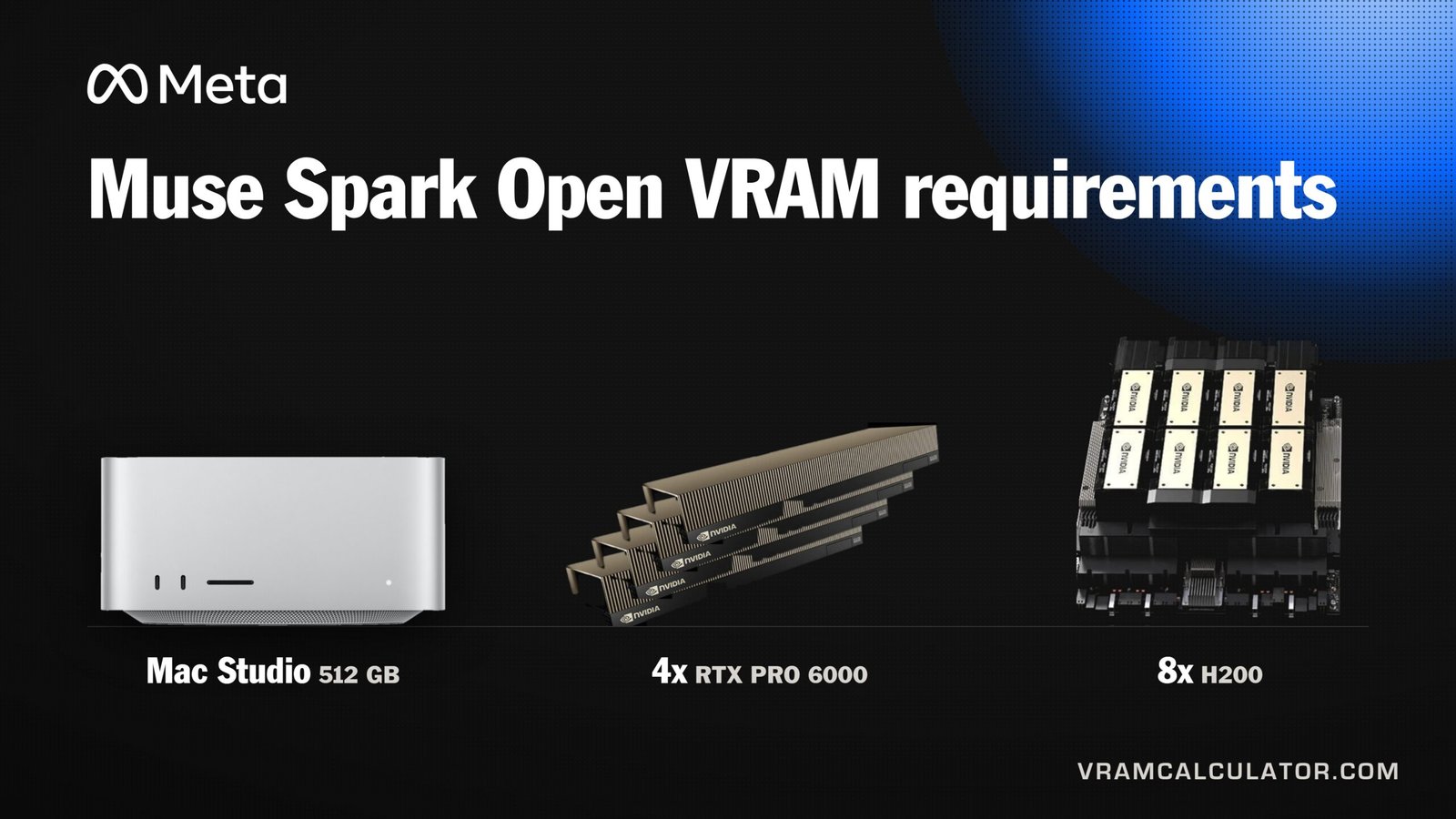
As of 15 October 2026, the calculator holds it on three kinds of machine: a 512 GB Ultra Mac at Q2_K, a multi-GPU server such as 8x H100 at Q4_K_M, and two B300 cards at Meta's NVFP4 build. Try your own setup in the VRAM calculator, where the model is listed as Muse Spark Open 816B / 42B active.
The builds, from the files
Every size below is a file listing on Hugging Face, summed in decimal GB (for Meta's NVFP4 build that is the 533.01 GB of weight files; the whole repo, with config and tokenizer files, is 533.04 GB). The calculator's totals are in GiB, which is what cards and Macs report, so the 533.01 GB of NVFP4 weights is 496.4 GiB, and the 8K total in the last column adds the cache and overhead to that.
| Build | Publisher | File size | Total at 8K |
|---|---|---|---|
| BF16 | Meta | 1,644.33 GB | 1,547.9 GB |
| Q8_0 | ggml-org | 871.65 GB | 821.1 GB |
| NVFP4 | Meta | 533.01 GB | 502.5 GB |
| UD-Q4_K_XL (Q4_K_M rung) | Unsloth | 505.50 GB | 476.7 GB |
| UD-Q3_K_XL (Q3_K_M rung) | Unsloth | 401.48 GB | 378.8 GB |
| UD-Q2_K_XL (Q2_K rung) | Unsloth | 311.23 GB | 293.9 GB |
Below Q2_K the files keep going: Unsloth publishes UD-IQ3_XXS at 340.35 GB, UD-IQ2_S at 275.50 GB, UD-IQ2_XXS at 225.57 GB, UD-IQ1_M at 208.93 GB and UD-IQ1_S at 175.64 GB (163.6 GiB). The calculator has no rung for these yet, so any fit on them is file arithmetic, not a calculator verdict. ggml-org's own set tops out at Q8_0 and goes down to Q4_K_S at 470.07 GB and Q2_K at 304.08 GB. The vision and audio side needs a separate mmproj file of about 4.1 GB.
Apple builds from mlx-community are 461.72 GB at 4-bit and 359.24 GB at 3-bit. AMD publishes Quark builds, created on 18 September 2026: Muse-Spark-Open-816B-A42B-Quark-MXFP4 at 508.86 GB in 65 safetensors shards and Quark-PTPC-FP8 at 832.75 GB.
Meta's "4-bit" build is larger than Unsloth's Q4
The NVFP4 repo is 27.5 GB larger than Unsloth's UD-Q4_K_XL, which surprises anyone who reads NVFP4 as a smaller format. The tensor census in the repo's metadata explains it. It holds 386,547,056,640 bytes of packed 4-bit values, which is 773.09B weights at two a byte, plus 48,318,382,080 FP8 scales (one per 16 weights, an exact match) plus 48.81B weights left in BF16. So about 94% of the weights are 4-bit and about 6% stay at 16 bits, which lands at 5.19 bits per weight overall. UD-Q4_K_XL lands at 4.92. NVFP4 is the build that needs a Blackwell card, and the calculator flags that on its GPU list.
What holds it
The table shows what fits at 128K of context, using the calculator's pooled capacity for each machine. It is capacity before any engine's own split losses, and multi-card pools lose some to interconnect.
| Machine | Usable memory | Holds at 128K |
|---|---|---|
| 256 GB Ultra Mac | 166.4 to 192.0 GB | None of the calculator's rungs; by file arithmetic only the 163.6 GiB UD-IQ1_S gets near it |
| 4x RTX PRO 6000 Blackwell 96GB | 325.4 GB | Q2_K (301.6 GB) |
| 512 GB Ultra Mac | 332.8 to 384.0 GB | Q2_K (301.6 GB), not Q3_K_M (386.5 GB) |
| 8x H100 80GB | 542.4 GB | Q2_K, Q3_K_M, Q4_K_M (484.4 GB), not Q8_0 |
| 2x B300 288GB | 523.6 GB | Q2_K up to NVFP4 (510.2 GB), not Q8_0 |
| 4x B200 192GB | 650.8 GB | Q2_K up to NVFP4, not Q8_0 |
| 8x H200 141GB | 955.9 GB | Q8_0 (828.8 GB), not BF16 (1,555.6 GB) |
A single card does not get there, with one exception in the calculator: the catalogue lists the Instinct MI430X with 432 GB, 411.4 GB usable, which holds Q2_K and Q3_K_M. One B300 offers 274.3 GB, and a single MI300X or B200 offers 182.9 GB, so neither holds even Q2_K at 293.9 GB. The MI430X is the only single-card answer on the list, and its capacity is the catalogue's figure for a part that few people can buy.
Macs
The Mac numbers carry an assumption. Our Mac model gives the GPU 65% to 75% of unified memory because macOS publishes no formula, which is why a 512 GB machine shows a range, and you can enter your own limit in the calculator. Against that range, the 3-bit MLX build is 334.6 GiB of files before any cache, at the bottom edge, and the 4-bit build is 430.0 GiB, above the top. The mlx-community card for the 4-bit build says it "takes about 462 GB, which leaves little room for the KV cache on a 512 GB Mac." For other Ultras, see the M5 Ultra Mac Studio guide.
What the context costs
This is where Muse Spark Open differs from most models this size. Only 16 of its 62 layers use full attention. The other 46 look back 2,048 tokens and no further, the same layer recipe as the Muse Glimmer. The full layers hold 16 KV heads of 64 dimensions, so the cache costs 64 KiB a token: 8 GiB at 128K and 64 GiB at 1M. The 46 windowed layers add 0.36 GiB at any context.
On Q2_K the totals are 293.9 GB at 8K, 301.6 GB at 128K and 359.1 GB at 1M. So 128K costs 7.7 GB over 8K, and the full 1M costs 65.2 GB. Choosing Q4_K_M instead of Q2_K costs 182.8 GB. The maximum context in the model's config is 1,048,576 tokens. The practical rule: pick the machine for the weights, then check the cache, because the cache is the smaller number here.
The 700 GB claim, checked
The claim going around, from @MiaAI_lab on 15 October, is that the NVFP4 build needs 700 GB of VRAM. The post gives no method; its image is a graphic, not a log. The files do not say that. Meta's NVFP4 weights are 533.01 GB. With an 8K cache and overhead the calculator puts it at 502.5 GiB, about 539.6 GB, and at the full 1M context at 567.7 GiB, about 609.5 GB. Both are under 700 GB. The likely whole of the gap is a runtime that preallocates a KV pool against our cache arithmetic, but nobody has published a method for the 700 figure yet. On a Blackwell pool the answer is two B300 cards for contexts up to 256K (518.4 GB against 523.6 usable), or four B200 cards for the full 1M.
The calculator's numbers describe one request on llama.cpp. They are not a measurement of vLLM or SGLang on a Blackwell rack, which we have not run, so a serving setup that reserves more cache can use more than the table shows.
What Meta says Muse Spark Open scores
These are Meta's figures from its own model card, run at xhigh reasoning effort with temperature 1.0 and top_p 1.0, against other open-weight models of similar size and architecture. They are vendor numbers. Meta's evaluation report says its results for third-party models are "best-effort evaluations" that "may not reflect their best provider-optimized performance." Treat the table as Meta's claim until an independent run repeats it.
Meta's strongest rows are the agentic and knowledge ones: MCP-Atlas 89.2, JobBench 61.8, HLE-Diamond without tools 26.1 and AA Omniscience 25. On the computer-use test OSWorld Verified it reports 80.4, with Kimi K3 at 84.8 in the same table. The weaker rows are coding and the composite index: Terminal-Bench 2.1 at 76.4, DeepSWE 1.1 at 60 and an Artificial Analysis Intelligence Index of 39, which Artificial Analysis's own Muse Spark Open page also shows, on index version v4.3.2. In the multimodal rows Meta lists only Kimi K3 as a comparison, and Muse Spark Open leads on ZeroBench (50.0 against 41.0), SimpleVQA (73.6 against 71.9) and IntPhys2 (68.3 against 60.3) and trails on BabyVision (80.2 against 85.7), WorldVQA (49.4 against 51.0) and VideoMMEv2 (61.5 against 65.4).
Muse Spark Open against GLM 5.3
GLM 5.3 is in Meta's own comparison table, at max reasoning effort, so Meta has put the two side by side itself. Z.ai's card for GLM-5.3 publishes its own figures and does not list Muse Spark Open. The table below sets Meta's row for each model next to Z.ai's figure for GLM 5.3 where Z.ai publishes the same benchmark.
| Benchmark | Muse Spark Open (Meta) | GLM 5.3 (Meta's table) | GLM 5.3 (Z.ai's card) |
|---|---|---|---|
| Artificial Analysis Intelligence Index (v4.3.2) | 39 | 45 | not published |
| MCP-Atlas | 89.2 | 84.2 | not published |
| JobBench | 61.8 | 61.4 | not published |
| HLE-Diamond (no tools) | 26.1 | 16.4 | not published |
| AA Omniscience | 25 | 14 | not published |
| GPQA Diamond | 89.0 | 91.7 | not published |
| SciCode | 58.5 | 59.0 | not published |
| Toolathlon Verified | 72.8 | 73.0 | 73.0 |
| HLE (w/ tools) | 61.0 | 62.5 | 62.5 |
| DeepSWE 1.1 | 60 | 67 | 66.9 |
| Terminal-Bench 2.1 | 76.4 | 83.9 | 88.2 |
| GDPval-AA v2 | 1401 | 1653 | 1769 |
On Meta's numbers the split is clean. Muse Spark Open is ahead on MCP-Atlas by 5 points, on HLE-Diamond by 9.7 and on AA Omniscience by 11, and within 1.5 points of GLM 5.3 on JobBench, Toolathlon, SciCode and HLE with tools. GLM 5.3 is ahead on the Intelligence Index (45 against 39 on version v4.3.2, the same figures Artificial Analysis shows on its GLM-5.3 page), GPQA Diamond, DeepSWE, Terminal-Bench 2.1 and GDPval-AA v2. The pattern in Meta's table is that Muse Spark Open does better on tool use and recall, and GLM 5.3 does better on coding and the GDPval-AA v2 work-task test.
Where Meta's GLM figures and Z.ai's disagree
Two of the five rows where both companies publish a GLM 5.3 figure do not match. Meta lists 83.9 on Terminal-Bench 2.1 and Z.ai lists 88.2, a gap of 4.3 points. On GDPval-AA v2 Meta lists 1653 and Z.ai 1769. The evaluation report explains why: Meta took both from Artificial Analysis runs, using the Terminus 2 harness for Terminal-Bench 2.1 and runs dated 7 October 2026 for GDPval-AA v2, rather than from Z.ai's self-report. On Toolathlon Verified and HLE with tools Meta cites GLM 5.3's own numbers, and they match Z.ai's card exactly. So a Terminal-Bench 2.1 gap of 7.5 points between the two models is a gap between Meta's run of Muse Spark Open and an independent run of GLM 5.3. On Z.ai's own figure it would be 11.8.
What each needs in memory
Both models are in the calculator: Muse Spark Open as Muse Spark Open 816B / 42B active, and GLM 5.3 as GLM-5.3 753B MoE. Totals below are the calculator's at 128K of context on llama.cpp with an F16 cache, weights plus cache plus overhead.
| Build | Muse Spark Open at 128K | GLM 5.3 at 128K |
|---|---|---|
| Q2_K | 301.6 GB | 251.0 GB |
| Q3_K_M | 386.5 GB | 334.8 GB |
| Q4_K_M | 484.4 GB | 451.7 GB |
| NVFP4 | 510.2 GB | 448.8 GB |
| Q8_0 | 828.8 GB | 766.0 GB |
| BF16 | 1,555.6 GB | 1,430.6 GB |
GLM 5.3 is smaller at every rung: 50.6 GB less at Q2_K, 32.7 GB less at Q4_K_M and 61.4 GB less at NVFP4. That moves two machines. A single B300 holds GLM 5.3 at Q2_K (251.0 GB against 274.3 usable) and holds no Muse Spark Open build. A 512 GB Ultra Mac (332.8 to 384.0 GB) holds both models at Q2_K. At Q3_K_M it holds GLM 5.3 only at the top of its range (334.8 GB) and never Muse Spark Open (386.5 GB). Four RTX PRO 6000 cards (325.4 GB) hold neither at Q3_K_M. Two B300 cards hold both models up to NVFP4 at 128K.
Context is the one place the order flips. The cache grows by 94.1 GB from 8K to 1M on GLM 5.3's Q2_K, against 65.2 GB on Muse Spark Open. At 1M, that growth takes GLM 5.3 at NVFP4 to 531.8 GB, past the 523.6 GB of two B300 cards, and Muse Spark Open at NVFP4 is 567.7 GB. Four B200 cards (650.8 GB) hold both.
GLM 5.3's sizes in this section are the published files: Unsloth's for Q2_K to BF16 and NVIDIA's NVFP4 build. The full ladder is on the GLM 5.3 page.
Check your own machine
The what LLM can I run page takes a GPU and returns every model in the catalogue that fits, and the calculator takes a model and returns the cards. Muse Spark Open is in both. Sibling launches get the same treatment on Kimi and GLM.
FAQ
How much VRAM does Muse Spark Open need?
At 8K of context, 293.9 GB at Q2_K, 476.7 GB at Q4_K_M and 502.5 GB for Meta's NVFP4 build, from file sizes plus cache and overhead. The BF16 weights alone are 1,644.33 GB.
Can one GPU run Muse Spark Open?
Only one entry in the calculator can: the Instinct MI430X 432GB at Q2_K or Q3_K_M. A B300 (274.3 GB usable) cannot hold the smallest mainstream build.
Can a Mac run Muse Spark Open?
A 512 GB Ultra Mac holds Q2_K at 128K (301.6 GB against 332.8 to 384.0 GB). MLX has a 3-bit build at 359.24 GB and a 4-bit at 461.72 GB, and the 4-bit build leaves little room for the cache on 512 GB, by the mlx-community card's own words.
Does NVFP4 need 700 GB of VRAM?
No by the files: Meta's weights are 533.01 GB, and the calculator totals are 502.5 GB at 8K and 567.7 GB at 1M context.
How much does a 1M context cost on Muse Spark Open?
64 GB for the cache on the 16 full-attention layers, plus 0.36 GB for the windowed layers, which is 65.2 GB more than at 8K on Q2_K. At 128K it is 7.7 GB.