Can a mining card really download more RAM?
It can, and the meme finally came true in the middle of the RAM and VRAM crisis. In 2021 NVIDIA sold the CMP 170HX to Ethereum miners for $4,299, built on the same GA100 silicon as the A100 and locked down hard. LTT Labs says the used price had fallen to a few hundred dollars by June 2026. Then a software exploit restored the compute NVIDIA had switched off and exposed HBM2e memory that was physically on the board all along: 64 GB on the common 8 GB cards, 40 GB on the 10 GB cards through the tool's stable profile (cmpunlocker README).
LTT Labs opened its write-up with the joke: a long history of scams and malware promises more RAM, and cmpunlocker "actually follows through" for this card (LTT Labs). Tom's Hardware ran it under a headline about a $250 CMP 170HX with 64 GB of VRAM unlocked (Tom's Hardware, 18 August 2026), and wccftech reported prices going from about $100 to over $1,000 within days (wccftech, 7 August 2026).
Below: what the card is, the bandwidth myth, why it existed, how the unlock was found and how it works, the method, LLM benchmarks against an RTX 3090 Ti, the memory lottery, and a verdict. Every figure is attributed to the person or lab who measured it. We did not run this card.
What is the NVIDIA CMP 170HX?
The CMP 170HX is the flagship of NVIDIA's Cryptocurrency Mining Processor (CMP) line, a product family created during the 2021 GPU shortage to divert miners away from GeForce cards (NVIDIA's announcement). Unlike every other CMP card, which recycled consumer-grade silicon (GTX 1660 Super through RTX 3080 class), the 170HX is built on GA100: the same 826 mm2, 54.2-billion-transistor die that powers the A100 datacenter accelerator (LTT Labs).
The card surfaced in September 2021 and hit the market that fall at $4,299-4,300, pitched purely at Ethereum miners: no display outputs, a fully passive heatsink (the card ships with no fan at all), a 250W TDP, and roughly 164 MH/s of Ethash hashrate (wccftech, 2021, wccftech, ThinkComputers). Two variants circulated, 8 GB and 10 GB, both using HBM2e memory with a spec bandwidth of 1.49-1.56 TB/s. Independent measurement put the real-world figure at 1,355 GB/s, comfortably above the RTX 4090's ~1,000 GB/s and essentially matching the A100 PCIe 40 GB (LTT Labs, niconiconi).
One nuance most articles miss: the variants are binned differently. TechPowerUp's widely-copied specs (4,480 CUDA cores across 70 SMs, 280 tensor cores) describe the common 10 GB card; the dedicated 170th Street documentation reports that 8 GB cards ship further cut down, with 3,584 CUDA cores across 56 SMs and 224 tensor cores (170th Street). The table below uses the 10 GB-baseline figures you will see quoted everywhere (LTT Labs).
Table 1. CMP 170HX vs. its siblings (TechPowerUp data as tabulated by LTT Labs) (LTT Labs)
| Spec | CMP 170HX | A100 40 GB | RTX 3090 Ti |
|---|---|---|---|
| Release (launch price) | Sept 2021 ($4,299) | June 2020 ($8,000-12,000) | Mar 2022 ($1,999) |
| Architecture / process | Ampere, 7nm TSMC | Ampere, 7nm TSMC | Ampere, 8nm Samsung |
| CUDA cores | 4,480 (70 SM) | 6,912 (108 SM) | 10,752 (84 SM) |
| Tensor cores | 280 | 432 | 336 |
| Memory | 8 GB / 10 GB HBM2e | 40 GB HBM2 | 24 GB GDDR6X |
| Memory bandwidth | 1.49 / 1.56 TB/s | 1.56 TB/s | 1.01 TB/s |
| FP16 tensor (peak) | 202.2 TFLOPS | 311.9 TFLOPS | 160 TFLOPS |
| TDP | 250W | 250W | 450W |
The 'Bandwidth Penalty': What NVIDIA Actually Locked
You will see the phrase 'bandwidth penalty' all over CMP 170HX threads, and it deserves a correction right away: NVIDIA did not cripple the memory bus. From day one, the card shipped with its full ~1.5 TB/s HBM2e bandwidth. The definitive October 2023 deep-dive measured 1,355 GB/s with clpeak on a stock card and showed it beating an RTX 4090 in memory-bound workloads, 'all GB/s without FLOPS', as the review's title put it (niconiconi). The community briefing behind the 2026 unlock says the same thing: the HBM width 'was always there' (Stefano Pineda). The mining card's defining trait was never a bandwidth cut. It was an extreme imbalance between memory and math.
What NVIDIA actually locked, according to the teardown record and the 2026 unlock research (cmpunlocker README, Stefano Pineda, niconiconi, 170th Street):
FP32 FMA throughput: throttled to ~0.39 TFLOPS, slower than a 2008-era GPU and slower than a modern CPU; ready-made CUDA software was effectively unusable (niconiconi, 170th Street).
Tensor paths: ~6.2 TFLOPS in the stock configuration versus ~94 TFLOPS measured after the unlock; community reports of 6.3 to 193 TFLOPS (FP16 tensor) line up with the card's 202 TFLOPS paper spec (cmpunlocker README, Jon Pry's paper, r/LocalLLM post).
Memory capacity: only 8 GB or 10 GB of the physically packaged HBM2e was addressable. The 8 GB cards carry four HBM2e stacks holding 64 GB in total; the 10 GB cards carry five stacks holding 80 GB (cmpunlocker README, LTT Labs, wccftech).
PCIe: firmware-locked to Gen1 and hardware-crippled to x4 by omitting the AC-coupling capacitors for 12 of the 16 lanes from the PCB (cmpunlocker README, niconiconi, 170th Street).
ECC and Resizable BAR: absent in the stock configuration, with BAR1 capped at 64 MB; the October 2026 cmpunlocker releases now unlock ECC (DRAM and SRAM) and the full 64 GB BAR1 (cmpunlocker README, niconiconi).
Why ship a card this lopsided? Because Ethereum's Ethash algorithm is memory-hard: it punishes huge integer-and-bandwidth workloads, not floating-point math. NVIDIA kept integer throughput relatively uncapped (~12.5 TIOPS, about 60% of an A100) because that is what mining needs, while gutting exactly the capabilities, FMA, tensors, that would have let the card eat into $8,000-12,000 A100 sales (LTT Labs, niconiconi). Binned GA100 dies that missed datacenter quality thresholds got a second life as mining hardware instead of being written off entirely (170th Street).
Why the Card Was Released: The 2021 Story
The CMP line was announced on February 18, 2021, in a blog post that opens 'We are gamers, through and through', released at the exact moment RTX 3060 cards began shipping with software that detected and throttled Ethereum mining (LTT Labs, NVIDIA's announcement). The message to players was protective, and the message to miners was commercial: NVIDIA would sell you a dedicated card instead. The CMP 30HX, 40HX, 50HX and 90HX covered the mid-range; the 170HX was the halo product, announced far more quietly in fall 2021 .
The card solved two problems for NVIDIA at once. First, miners were buying every GeForce card in sight during the shortage, and gamers were furious. Second, the A100 binning process was producing GA100 dies with too many defects for the datacenter, the 170HX gave those marginal dies a paying job (LTT Labs, 170th Street). Notably, a fully enabled 128-SM GA100 never shipped in any product, and the CMP's own silicon was from the lower bins . An academic estimate cited by LTT Labs puts total production between 18,000 and 36,000 cards (Xing Kangwei's paper).
When Ethereum moved to proof-of-stake in 2022, the 170HX lost its only purpose. No display outputs, no meaningful 3D rendering, gutted compute, and prices collapsed: niconiconi reports $400-500 in China by late 2023, and the cmpunlocker coverage puts the used price as low as $200-300 by June 2026 (cmpunlocker README, niconiconi). Then the unlock happened, and Stefano Pineda's write-up says the market re-rated the same silicon roughly 5x in a single week (Stefano Pineda).
The Road to the Unlock (2023-2026)
The unlock did not appear out of nowhere. The community spent three years peeling back layers, each step documented in public:
October 2023: the niconiconi teardown-and-review documents the full memory bandwidth, the FMA throttle, the PCIe capacitor situation, and rules out VBIOS modding due to firmware signing (niconiconi).
2023-2024: driver-patching projects (notably dartraiden's NVIDIA-patcher, whose issue #73 became the long-running CMP 170HX thread) restore CUDA paths for mining GPUs on Windows; for the 170HX, application-level workarounds dominate (NVIDIA-patcher issue 73).
April 2025: Xing Kangwei's paper (arXiv:2505.03782) demonstrates disabling FMA instructions in CUDA source code, recovering >15x FP32 performance and >3x inference speed on some quantized LLM workloads, without touching firmware (Xing Kangwei's paper).
June 26, 2026: Jon Pry publishes 'A Canary in the Crypto Mine: Defeating Stack Protection in a GPU Secure Coprocessor', the paper that cracks the card's secure-boot chain wide open (Stefano Pineda, Jon Pry's paper, Tom's Hardware).
July 2026: Amogh Munikote releases cmpunlocker, a driver-level tool that turns the paper into a one-command unlock; the first working memory unlock lands July 18, PCIe Gen2 on July 29 (cmpunlocker README, Stefano Pineda).
August-September 2026: wccftech and Tom's Hardware cover the price explosion from ~$250 to over $1,000; LinusTechTips publishes a full video feature with LTT Labs' reference article (LTT Labs, wccftech, Tom's Hardware).
October 2026: cmpunlocker keeps shipping: GPU profiling (Sept), then ECC DRAM/SRAM and full BAR1 (early Oct), plus support for the 615.78.08 driver branch (cmpunlocker README).
How the Unlock Works (Plain Language)
The CMP 170HX's restrictions live in firmware and OTP configuration, enforced by NVIDIA's Falcon security coprocessor through a signed secure-boot process ('Heavy Secure') (Stefano Pineda, Jon Pry's paper). Pry's paper found the whole structure rests on a memory-safety bug: the stack canary, the guard value meant to detect buffer overflows inside the secure coprocessor, sits in writable data memory on the overflow path. An attacker who fills that memory uniformly makes the guard equal to its saved copy, so the security check degenerates into V == V and always passes .
From there, the exploit chain runs in five steps: load a legitimately signed booter (no keys are forged); exploit an unbounded-DMA regression in the open-kernel-modules-era booter to execute code inside the secure domain; reach the Heavy Secure code and open the privilege level masks (PLMs) that block host writes; then simply write the fuse-override registers that control SM issue rate, memory geometry and PCIe generation from the host (Stefano Pineda). Crucially, nothing is permanently burned, the unlock is a software state, no NVIDIA signing keys were extracted, and the values persist across driver reloads until a full power cycle clears the always-on island (LTT Labs).
Two details make this practical rather than a lab stunt. First, the attack rides on NVIDIA's own AES-encrypted, RSA-signed gsp_tu10x.bin booter blob, which ships with all NVIDIA drivers from the 570 to 610 series, there is nothing to counterfeit (Stefano Pineda, NVIDIA-patcher issue 73). Second, cmpunlocker moves the PLM-opening into the patched open-source driver itself, so it happens in kgspPrepareForBootstrap before GSP-RM boots, which is why the unlock survives reboots and works system-wide once installed (cmpunlocker README).
The Unlock Method, Step by Step
The method below is the one documented in the cmpunlocker repository and independently walked through by LTT Labs on three cards (cmpunlocker README, LTT Labs). You need: a Linux x86-64 host with root, an NVIDIA CMP 170HX, Secure Boot disabled (the patched modules are unsigned), the nvidia-open 610.43.02/03 driver (support for 615.78.08 was added in October 2026, always check the repo for the currently supported branch), kernel headers matching your running kernel, and Python 3 .
Disable Secure Boot in your BIOS and confirm it with
mokutil --sb-state.Remove existing NVIDIA drivers:
sudo apt purge '^nvidia-.*'.Blacklist nouveau in
/etc/modprobe.d/blacklist-nouveau.conf(addblacklist nouveauandoptions nouveau modeset=0), rebuild initramfs withsudo update-initramfs -u -k all, and reboot.Pin the driver version with an apt preferences file targeting 610.43.02, then install:
sudo apt update && sudo apt install nvidia-open nvidia-persistenced.Clone the tool:
git clone https://github.com/amoghmunikote/cmpunlocker.git.Run
sudo ./install.sh, it auto-detects your card; you can force a profile with--profile=8gb(unlocks 64 GB) or--profile=10gb(stable 40 GB).Reboot, the community runbook recommends a full cold power-off of about 60 seconds so the always-on state fully clears; a hot reload can lie to you (cmpunlocker README, Stefano Pineda).
Verify:
nvidia-smishould report 65,536 MiB on an 8 GB card (40,960 MiB on the stable 10 GB profile), anddmesg | grep SEC2_DEBUGshould show the PLM writes.Stress-test the unlocked memory with memtest_vulkan before trusting it, the standard run is five minutes; two hours is recommended for a production card (cmpunlocker README, LTT Labs).
To revert:
sudo ./remove.sh --yes, then reinstall clean drivers, LTT Labs found the re-lock path leaves the system in an odd state, so a full driver reinstall is the tidy way back (cmpunlocker README, LTT Labs).
Fair warnings before you run any of this: it requires root and an unsigned kernel module, and it voids whatever warranty expectations remain on a five-year-old mining card. You are responsible for your own actions and your own hardware; we share this information for educational and informational purposes. It needs attention after every driver or kernel update. None of this is a beginner's first Linux project (cmpunlocker README, LTT Labs, Stefano Pineda).
What the unlock sheet adds
The full variant unlock sheet is in Issue 2 of The Local LLM Sizing Guide: how to tell the 8 GB Hynix card from the 10 GB Samsung card, the three unlock paths, and the decision matrix that says which one to run on which card. Issue 2 is the one to read before you order a card or open a terminal; the guide's page has the details.

The Local LLM Sizing Guide. Issue 1, 30 September
An 8 GB CMP 170HX unlocks to 64 GB. The 10 GB one stops at 40. Know which you hold before you pay.
The variant unlock sheet is in Issue 2: how to tell the two cards apart, the three unlock paths and the decision matrix.
From $9 a month. Card or crypto. The next issue included.
LLM Benchmarks: Locked vs Unlocked
LTT Labs ran llama-bench with a fixed configuration (-fa 1 -ngl 999 -n 128, prompts of 512 and 8,192 tokens) comparing the locked card, the unlocked card, and an RTX 3090 Ti (LTT Labs). Their caveat matters: these are out-of-the-box numbers with zero context depth, llama.cpp tuning can shift results either way. What the table shows is the hardware's personality in plain numbers :
Table 2. llama-bench results, LTT Labs, September 2026 (LTT Labs), pp = prompt processing (prefill), tg = token generation (decode), tokens/s; OOM = out of memory
| Model | Card | pp512 | pp8192 | tg128 |
|---|---|---|---|---|
| IBM Granite 4.1 8B Q4_K_M (~5 GB) | RTX 3090 Ti | 5,142 | 4,466 | 136 |
| IBM Granite 4.1 8B Q4_K_M | CMP 170HX (locked) | 351 | 306 | 30 |
| IBM Granite 4.1 8B Q4_K_M | CMP 170HX (unlocked) | 2,994 | 2,782 | 113 |
| Qwen 3.6 27B Q4_K_M (~16 GB) | RTX 3090 Ti | 1,567 | 1,501 | 47 |
| Qwen 3.6 27B Q4_K_M | CMP 170HX (locked) | OOM | OOM | OOM |
| Qwen 3.6 27B Q4_K_M | CMP 170HX (unlocked) | 907 | 888 | 38 |
| Qwen 3.8 27B Q8_0 (~29 GB) | 2x RTX 3090 Ti (layer) | 1,672 | 2,691 | 31 |
| Qwen 3.8 27B Q8_0 | CMP 170HX (unlocked) | 897 | 875 | 33 |
The pattern is exactly what the silicon predicts. Token generation is strong because decode is memory-bandwidth-bound and the HBM2e bus is enormous, on the 8B model the unlocked card reaches 113 tok/s, and a r/LocalLLM post reports tensor throughput jumping from 6.3 to 193 TFLOPS after the unlock (Jon Pry's paper, r/LocalLLM post). Prefill, which is compute-bound, still trails the RTX 3090 Ti by roughly 40%, its GPU simply computes much faster. Before the unlock, by contrast, Stefano Pineda's write-up cites one lab test that recorded only ~33 tok/s on Mistral 7B Q4 with dreadful prefill, because the FMA throttle meant most ready-made software crawled (Stefano Pineda).
The big gain after the unlock is capacity. LTT Labs ran every test at zero context depth, and says the unlocked 64 GB leaves room for the 262k-token context of most Qwen 3.6 and 3.8 27B and 35B models, or for several models at once. Its verdict is that the capacity cannot be matched by other consumer-available cards (LTT Labs). The visible weakness is host transfer: over the unlocked PCIe Gen2 x4 link, LTT Labs loaded a 16 GB Qwen 3.6 27B Q4_K_M in 11 seconds against 6 seconds on a Gen4 x16 RTX 3090 Ti. Its card with the twelve missing capacitors soldered on, giving Gen2 x16, loaded it in 6 seconds too; the same test measured about 6.7 GB/s over Gen2 x16 against 0.85 GB/s on the locked Gen1 x4 link.
One thermal reality check, from a Level1Techs forum build: the card is passive and, per that forum post, hits its 85C limit within minutes under LLM load without serious fan-and-shroud cooling, throttling performance accordingly. Budget for airflow the way you would for a used datacenter card, because that is what this is (Level1Techs).
Does PCIe matter for local LLMs?
The community runs publish their link speeds, and Gen2 is the ceiling in all of them (read 24 October 2026). cmpunlocker's README lists "PCIe Gen 2 speeds" as the unlocked feature, and its Gen 3/4 issue is still open. Gen3 code exists: a retrain path was merged in September with an NVreg_CmpPcieGen cap parameter (pull request 47), but the README does not list Gen3 as working. One commenter, darkmaniac7, dumped the fuses on four 8 GB cards and found the software override that a third-party Gen3 recipe relies on is blocked on them. They also report that their own register route stopped the card at Gen1 until a power cycle, and that Gen2 x8 is the ceiling on the 8 GB card (issue comment). A commenter on the same issue claims a 10 GB card reached PCIe 4.0 and calls it only slightly better than Gen3 (comment); we found no measurement of it.
Does it matter for LLMs? It depends on where the weights live. A model held entirely on one card pays in load time: LTT Labs' 16 GB model took 11 seconds over Gen2 x4 against 6 over Gen2 x16. The vLLM field report in the cmpunlocker repo runs Qwen 3.8 27B FP8 on one 64 GB card at about 79 tok/s warm median over Gen2 (pull request 58), so a resident model decodes at that rate over Gen2. It matters on several cards. g4bwy's four-card Qwen 3.8 Flash Next repo opens its limits with "PCIe is the limit" (Gen2, one card at x16, three at x4). GNmac-lab's DeepSeek V4.1 Flash 1017 repo says four-way tensor parallel needs x16 links and tells x1 or x4 owners to use pipeline parallel. bluespace3's repo calls tensor-parallel all-to-all "brutally slow" on Gen2 x4. It would also bite when experts or tables stream from system RAM or SSD, as in Strata or Maya or llama.cpp offload, because that traffic crosses the same link; the repos above that use CPU offload (g4bwy's engram setting, for one) run on this link too, and we found no figures that isolate its cost.
Morrowmake has published a four-card recipe for DeepSeek V4.1 Flash 1017 on PCIe Gen2 x16 links, with his own release check of 24 October 2026 (read 25 October). With four CMP 170HX cards at 180 W each and a 262,144-token context, he measured one user at 319 tok/s on structured output, 287 on code and 162 on prose, and eight users together at 765, 729 and 432, with a cold prefill of 3,808 tok/s on a 32K prompt (median of five runs, 400 tokens, temperature 0, thinking off). The requirements are steep. His repo says the layout is for cards with the x16 capacitor modification and that on x4 links it "runs, but bus-bound and much slower". It wants about 240 GiB of host RAM for the fast path, and with less the Engram tables are read from SSD, where his prose figures fall to 151 tok/s for one user and 428 for eight. It needs about 680 GiB of disk and his own vLLM fork, with the routed experts in EXL3 at 2.9 bits per weight and every other weight in DeepSeek's own FP8 or BF16. These are Morrowmake's numbers from one rig, we have seen no reproduction, and we did not run it (Morrowmake).
Reliability, risks and the memory lottery
The unlock exposes memory that NVIDIA binned for a reason, and this is where naive buyers get burned. Jon Pry's paper, as summarised by Stefano Pineda, found the full 80 GB addressable but unstable at stock refresh rates, 2,796 gpu-burn errors, while 40 GB ran clean; more aggressive refresh settings reached zero errors at about 32% less tensor throughput (64.6 against 94.6 TFLOPS) (Stefano Pineda). Pineda's synthesis of community reports converges on the same split: 8 GB Hynix cards (PCI ID 10de:20c2) reliably unlock to 64 GB at stock clocks, while 10 GB Samsung cards (10de:2082) can address 80 GB but frequently cannot sustain it, so the practical cmpunlocker profile is 40 GB (cmpunlocker README, wccftech). LTT Labs borrowed one card whose memory failed testing no matter the temperature (LTT Labs).
Beyond the silicon lottery, remember what these cards are: five-year-old mining hardware, with wear you cannot inspect and no warranty of any kind, as Tom's Hardware notes. LTT Labs warns that buyers are likely testing cards and reselling the ones with unstable memory, and a memory test on request is not a foolproof guarantee. Stefano Pineda reports sellers relabelling whatever they have as 'unlockable' and marketplace orders cancelled once stock ran out. An unlocked card still has limits. PCIe is the main one, covered in the section above. Until you trust your specific card, long unattended jobs should checksum their outputs.
What 64 GB holds in our tools
Our tools carry the unlocked cards beside the stock one, as of 24 October 2026: "CMP 170HX 64GB (unlocked)" and "CMP 170HX 40GB (unlocked)". The GPU checker sizes every model in the catalogue against either, and the homepage VRAM calculator takes the card, the quantization and the context. The 80 GB profile is not offered, because its reports are unstable. The 64 GB entry uses the stock 8 GB card's rated bandwidth of 1,493 GB/s, which the unlocked card's own proof run, 1,504 GB/s coalesced read in OpenCL-Benchmark, matches. The 40 GB entry uses the 10 GB card's rated 1,555 GB/s, since no measured figure for an unlocked 10 GB card has been published to replace it.
For the offloading engines, the Strata calculator and the Project Maya calculator list the same two cards. Big models are where 64 GB gets used: by our file-by-file count in DeepSeek V4.1 Flash 1017: Scores Better on the Same 510 GB, the network alone is 307.2 GB, which is five 64 GB cards on weights alone, before cache or overhead (our arithmetic). Strata runs the same model on one 12 GB card with 46 to 64 GB of RAM, as that article reports, and Strata's Qwen 3.8 Flash Next story shows the same idea on a 180B model.
Verdict: Is it worth it for local LLMs?
LTT Labs calls the dollars per GB of memory of an unlocked CMP 170HX unmatched, depending on how used prices develop (LTT Labs). At the $200-500 of June 2026 that was an extraordinary deal, and one viral post, quoted by Stefano Pineda, put it as 'the best local AI card of 2026 was sitting in an e-waste bin'. At LTT Labs' September 2026 used prices, $1,300-1,700 for the CMP 170HX with some listings above $2,000, the math is tighter: it lists an RTX 3090 Ti at $1,300-1,500 and a used A100 40 GB at about $3,500. The 3090 Ti beats the CMP at prefill and host transfer in LTT's runs, and the A100 adds ECC and PCIe Gen4. Prices move weekly, so check current listings before you decide.
Buy one if you want a single-user, long-context inference box (27B-class models at Q4-Q8, massive KV cache headroom), you are comfortable on Linux with pinned drivers and unsigned modules, you will stress-test memory before trusting it, and decode speed matters more to you than prefill. Skip it if you need prefill throughput, PCIe Gen4, display outputs, ECC-grade trust for multi-tenant serving, or plug-and-play Windows, a used RTX 3090 Ti/4090 or an A6000-class card will serve you better (cmpunlocker README, LTT Labs, Stefano Pineda).
Check your own card
- GPU checker: what LLM can I run?
- VRAM calculator
- Strata calculator
- Project Maya calculator
- DeepSeek V4.1 Flash 1017: Scores Better on the Same 510 GB
- Strata: Running Qwen 3.8 Flash Next on a 12 GB Card
- The Local LLM Sizing Guide, with the variant unlock sheet in Issue 2
Sources
- amoghmunikote/cmpunlocker, 'A tool to unlobotomize your NVIDIA card', GitHub README (v0.1, July 21, 2026; ECC and 615.78.08 support added October 2026). https://github.com/amoghmunikote/cmpunlocker
- 'Actually Download More RAM, NVIDIA CMP 170HX cmpunlocker', LTT Labs, Lucas N., September 12, 2026. https://www.lttlabs.com/articles/2026/09/12/cmp-170hx-cmpunlocker
- Stefano Pineda, 'CMP 170HX Canary Unlock, Reliability for Local AI' (research synthesis of the Pry paper, Reddit, X, GitHub and Hacker News), July 2026. https://stefanopineda.com/cmp170hx_canary
- 'NVIDIA CMP 170HX Cryptocurrency Mining Monster Card Spotted, Ampere GA100 GPU, 164 MH/s', wccftech, September 2, 2021. https://wccftech.com/nvidia-cmp-170hx-cryptocurrency-mining-monster-card-spotted-ampere-ga100-gpu-164-mh-s/
- 'NVIDIA CMP 170HX 8/10 GB Prices Explode From $100 to Over $1,000 Overnight After Tool Unlocks Hidden 64/80GB VRAM', wccftech, Hassan Mujtaba, August 7, 2026. https://wccftech.com/nvidia-cmp-170hx-8-10-gb-prices-explode-over-1000-usd-as-tool-unlocks-hidden-64-80gb-vram/
- 'NVIDIA CMP 170HX Cryptomining Card With 164 MH/s Hash Rate Spotted', ThinkComputers.org, September 2, 2021. https://thinkcomputers.org/nvidia-cmp-170hx-cryptomining-card-with-164-mh-s-hash-rate-spotted/
- niconiconi, 'All GB/s without FLOPS, Nvidia CMP 170HX Review, Performance Lockdown Workaround, Teardown, Watercooling, and Repair', October 25, 2023. https://niconiconi.neocities.org/tech-notes/nvidia-cmp-170hx-review
- amoghmunikote/170th-Street, community hardware documentation for the CMP 170HX (introduction, modifications, unlock), July 2026. https://github.com/amoghmunikote/170th-Street
- Jon Pry, 'A Canary in the Crypto Mine: Defeating Stack Protection in a GPU Secure Coprocessor', Zenodo / ResearchGate, June 26, 2026. https://www.researchgate.net/publication/408132536_A_Canary_in_the_Crypto_Mine_Defeating_Stack_Protection_in_a_GPU_Secure_Coprocessor
- NVIDIA CMP announcement press release, 'We are gamers, through and through', February 18, 2021, as reproduced by Geeks3d, February 19, 2021. https://www.geeks3d.com/20210219/nvidia-cmp-hx-cryptocurrency-mining-gpu-and-geforce-anti-mining-feature/
- dartraiden/NVIDIA-patcher, issue #73, '170hx (any cmp hx card) can run higher and higher fp32', the long-running CMP unlock thread, December 2023 through 2026. https://github.com/dartraiden/NVIDIA-patcher/issues/73
- Xing Kangwei, 'Exploration of Cryptocurrency Mining-Specific GPUs in AI Applications: A Case Study of CMP 170HX', arXiv:2505.03782, submitted April 30, 2025. https://arxiv.org/abs/2505.03782
- 'Nvidia crypto mining GPUs hacked to restore locked away VRAM in order to feed AI boom, software mod unlocks 64GB of VRAM on $250 CMP 170HX', Tom's Hardware, Zhiye Liu, August 18, 2026. https://www.tomshardware.com/pc-components/gpus/nvidia-crypto-mining-gpus-hacked-to-restore-locked-away-vram-in-order-to-feed-ai-boom-software-mod-unlocks-64gb-of-vram-on-usd250-cmp-170hx
- r/LocalLLM, 'Unlocked a CMP 170HX: 6.3 -> 193 TFLOPS tensor', community benchmark report, 2026. https://www.reddit.com/r/LocalLLM/comments/1vulabl/
- Level1Techs forum, 'Could not resist grabbing a CMP 170HX, and now I am in a sticky position', August 16, 2026 (real-world thermal and llama.cpp experience). https://forum.level1techs.com/t/couldnt-resist-grabbing-a-cmp-170hx-and-now-im-in-a-sticky-position/253947
- amoghmunikote/cmpunlocker, issue #9, PCIe Gen 3/4. https://github.com/amoghmunikote/cmpunlocker/issues/9
- amoghmunikote/cmpunlocker, pull request #47. https://github.com/amoghmunikote/cmpunlocker/pull/47
- amoghmunikote/cmpunlocker, issue #9, comment on the fuse dump of four 8 GB cards. https://github.com/amoghmunikote/cmpunlocker/issues/9#issuecomment-6308774138
- amoghmunikote/cmpunlocker, issue #9, comment on a 10 GB card at PCIe 4.0 (no measurement). https://github.com/amoghmunikote/cmpunlocker/issues/9#issuecomment-5977665772
- amoghmunikote/cmpunlocker, pull request #58. https://github.com/amoghmunikote/cmpunlocker/pull/58
- g4bwy, four-card Qwen 3.8 Flash Next repo. https://github.com/g4bwy/qwen3.8-flash-next-cmp-170hx
- GNmac-lab, DeepSeek V4.1 Flash 1017 repo. https://github.com/GNmac-lab/deepseek-v41-flash-1017-cmp170hx
- bluespace3, Qwen 3.8 Flash Next on two unlocked cards. https://github.com/bluespace3/qwen38-flash-next-170hx
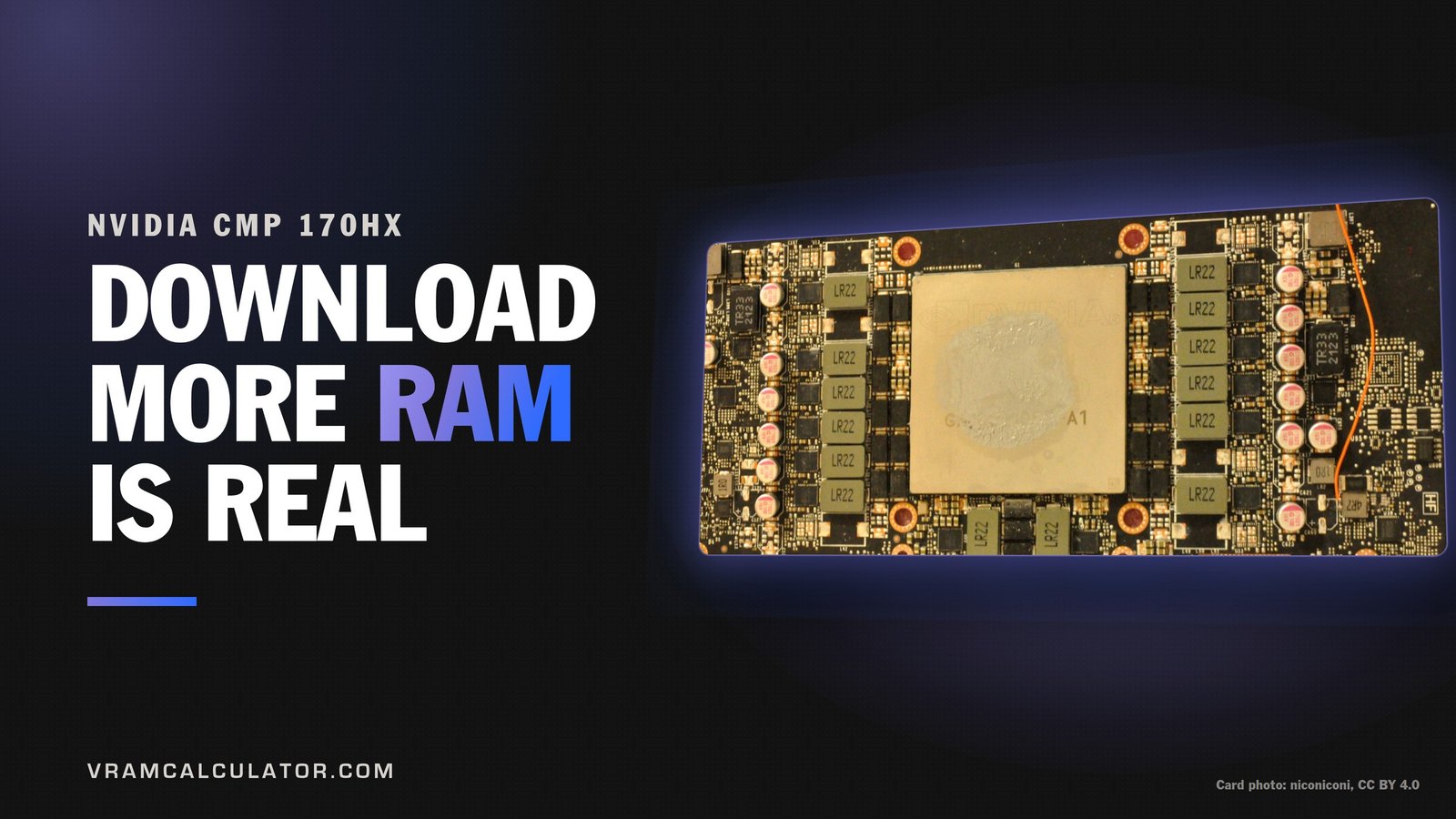
- Featured image: CMP 170HX board photo by niconiconi, from the review above, licensed CC BY 4.0 (https://creativecommons.org/licenses/by/4.0/), cropped. https://niconiconi.neocities.org/tech-notes/nvidia-cmp-170hx-review
- Morrowmake, 'DeepSeek-V4.1-Flash on 4x NVIDIA CMP 170HX', recipe repository, README, docs/results.md, docs/known-limits.md and docs/how-to-use.md, release 1.0.0, October 24, 2026. https://github.com/Morrowmake/dsv41-flash-cmp170hx-recipe
- Morrowmake, release post on X, 'Deepseek 4.1 Flash 1017 on 4 CMP 170HX', October 24, 2026. https://x.com/Morrowmake/status/2113973585731846414
FAQ
Was the CMP 170HX memory bandwidth really limited?
No, this is the most common misconception about the card. The HBM2e bus ran at its full ~1.5 TB/s from the factory, and independent clpeak measurement confirmed 1,355 GB/s on a stock card. NVIDIA locked compute (FMA/tensor paths), memory capacity (8-10 GB of 64-80 GB visible) and PCIe (Gen1 x4), but not bandwidth (cmpunlocker README, Stefano Pineda, niconiconi).
How much VRAM can the unlock expose?
It depends on your variant. 8 GB cards (Hynix memory) unlock to a stable 64 GB at stock clocks; 10 GB cards (Samsung memory) can address the full 80 GB but are typically limited to a stable 40 GB profile, since the binned memory often cannot sustain full speed (cmpunlocker README, LTT Labs, Stefano Pineda).
Is the unlock safe and permanent?
It is reversible: cmpunlocker is a driver-level patch (remove.sh re-locks the card), and the underlying exploit changes software state rather than burning fuses, no signing keys were extracted. The real risks are unstable binned memory, warranty loss, and breakage on driver updates (cmpunlocker README, LTT Labs, Stefano Pineda).
Does the CMP 170HX unlock work on Windows?
The documented method is Linux-only: root access, Secure Boot disabled, and the nvidia-open 610/615 driver series with matching kernel headers. The original research notes the exploit itself depends on NVIDIA's signed booter blob rather than the operating system, but the practical tooling targets Linux (cmpunlocker README, LTT Labs, NVIDIA-patcher issue 73).
What can you run on an unlocked 64 GB card?
LTT Labs ran Qwen 3.6 27B at Q4_K_M and Qwen 3.8 27B at Q8_0 on a single unlocked card, at 38 and 33 tok/s decode, and an IBM Granite 4.1 8B at Q4_K_M at 113 tok/s. All at zero context depth: it says the 64 GB leaves room for the 262k context of most Qwen 3.6 and 3.8 models, but did not benchmark that depth. Prefill is mid-tier against an RTX 3090 Ti. It suits single-user, long-context and multi-model setups rather than high-throughput serving (LTT Labs).
Is the CMP 170HX still worth buying at 2026 prices?
LTT Labs listed used CMP 170HX cards at $1,300-1,700 in September 2026, some above $2,000, up from a few hundred dollars in June (LTT Labs). It is still among the cheapest routes to 64 GB of HBM2e, but the margin over a used RTX 3090 Ti at $1,300-1,500 is narrow, and you take on the memory lottery and a Linux-only workflow to get there. Prices move weekly; read current listings.