Are the Intel Arc Pro B70 and B65 Good for Local AI?
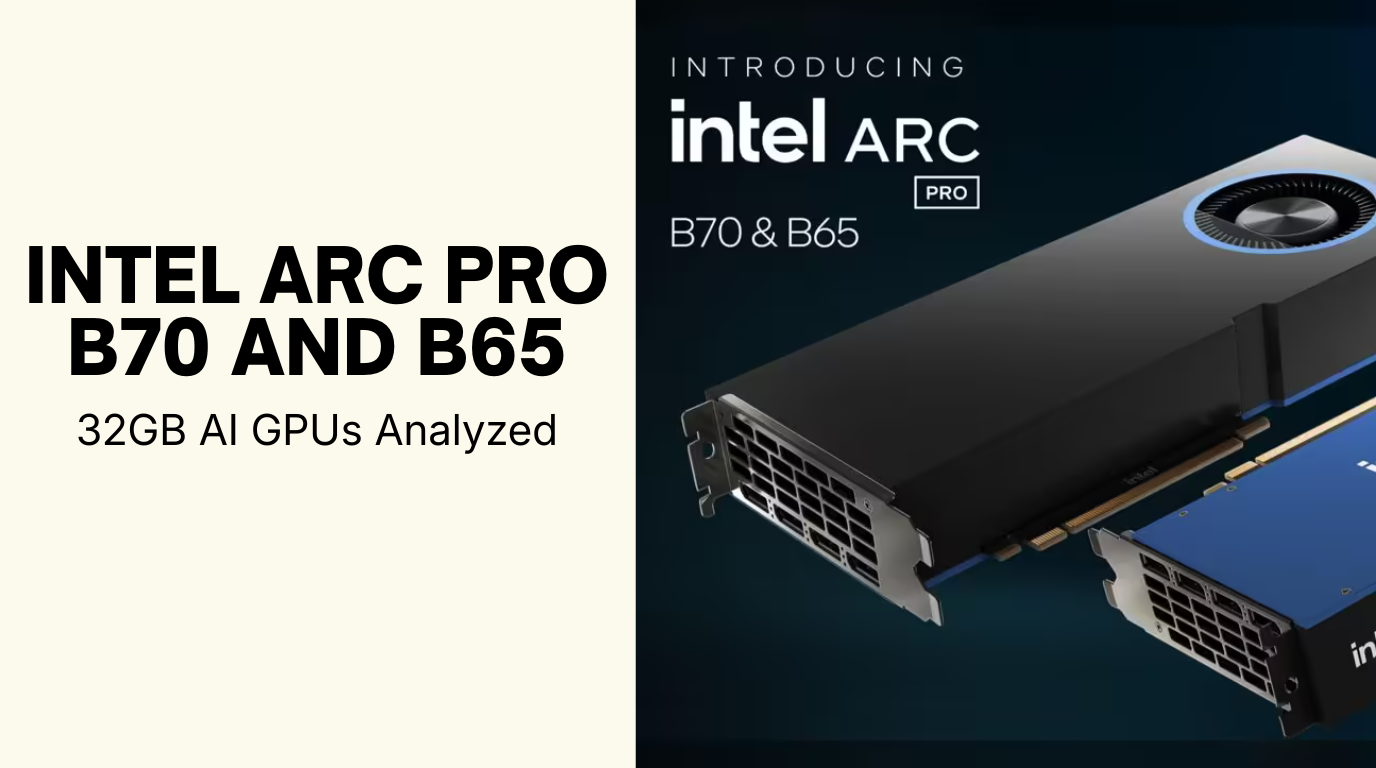
Yes, if your bottleneck is VRAM capacity rather than raw speed. The Arc Pro B70 puts 32 GB of GDDR6 behind a full 32-core Battlemage die for $949, and the B65 pairs the same 32 GB with a smaller 20-core die for $910 as of August 2026. Both are the cheapest new ways to get 32 GB on one card. Neither beats a used RTX 3090 at single-stream generation speed, and the software stack is the real trade-off.
Intel announced both cards on March 25, 2026 as workstation parts for "advanced AI compute workloads", naming local inferencing and multi-GPU rack deployments as the primary targets. That is not marketing gloss aimed at gamers: this is Intel explicitly entering the market our site covers. This analysis walks through the specifications, the real benchmarks published so far, pricing as of August 2026, and who should actually buy these cards.
The Lineup: Where B70 and B65 Sit
The two cards are the top of Intel's Battlemage workstation stack:
| Arc Pro B50 | Arc Pro B60 | Arc Pro B65 | Arc Pro B70 | |
|---|---|---|---|---|
| Xe2 cores | 16 | 20 | 20 | 32 |
| XMX engines | 128 | 160 | ~160 | 256 |
| Memory | 16 GB GDDR6 | 24 GB GDDR6 | 32 GB GDDR6 | 32 GB GDDR6 |
| Bus width | 128-bit | 192-bit | 256-bit | 256-bit |
| Bandwidth | 224 GB/s | 456 GB/s | 608 GB/s | 608 GB/s |
| TDP | 70 W | 120-200 W | 200 W | 230 W (160-290 partner range) |
| Launch | Sept 2025 | Q3 2025 | announced Mar 2026 | announced Mar 2026 |
The B70 is the first Battlemage card to use the full BMG-G31 die: 32 Xe2 cores, 256 XMX engines, 32 ray tracing units, and the complete 256-bit memory interface, per Intel's launch specification. Every earlier consumer Battlemage part (B580, B570) shipped with the die cut down. The B65 is the same 20-core die configuration as the B60 wearing the B70's memory system: 32 GB of GDDR6 on the full 256-bit bus at 608 GB/s. Several vendor pages say otherwise and they are wrong. ASRock's own B65 listings print a 192-bit interface, and VideoCardz reported Intel repeating that figure in its own launch material before it was corrected. The arithmetic settles it without waiting for Intel: 2 GB GDDR6 modules give 12 GB on a 192-bit bus, or 24 GB in clamshell. 32 GB does not populate 192 bits with parts that exist.
Specifications That Matter for Inference
For local LLM work, four numbers decide everything:
Memory capacity: 32 GB on both cards. This is the headline. It means a 27B-class dense model runs at Q8_0 (near-lossless) entirely in VRAM, which no 24 GB card can do. It means a 30B-A3B MoE runs at Q6 with room for long context. Four B70s reach 128 GB, enough for Kimi-K2-Class models at low quant or a 70B dense model at Q8.
Bandwidth: 608 GB/s on both cards. Single-stream decode speed scales almost linearly with bandwidth, which is why this number decides how a card feels in interactive use. 608 GB/s sits well below the RTX 3090's 936 GB/s and far below the 4090 and 5090 class above it. It also means the two cards should decode at the same speed for one user: what the B70 buys over the B65 is compute, not memory speed. Size any model against either card in our VRAM calculator, or start from the card in the GPU checker.
Compute: 367 TOPS INT8 on the B70 per Intel's announcement. That matters for batched serving and prefill, less for single-user decode, which is bandwidth-bound.
PCIe: 5.0 x16 on both. Notably, the B65 gets the full x16 link where the consumer B580 was cut to x8, again from Intel's launch specification. For multi-GPU tensor parallelism over PCIe, this helps.
What the Real Benchmarks Show
The only substantive independent benchmark set published so far comes from Wendell at Level1Techs, who tested a retail B70 on launch day with vLLM and Qwen3.5-27B. These are Tier 2 numbers: named tester, published methodology, reproducible commands. Everything below is attributed to that testing.
Four B70s, 50 concurrent requests, Qwen3.5-27B BF16, 1024-token input: 369.83 tok/s output throughput sustained, peaking at 550 tok/s, mean time to first token 11.47 seconds. A comparable 4x RTX 3090 setup in the same test delivered roughly 348 tok/s with worse TTFT at about 18.7 seconds, per Hardware Corner's summary of that data. In server-style batched serving, the B70 quad competes with or edges past the 3090 quad while costing less than one RTX 5090 at current pricing.
Single request, one B70, Qwen3.5-27B FP8 dynamic quant: 13.4 to 14 tok/s generation, 85.4 tok/s prompt processing. That single-stream figure is the honest ceiling for interactive use and confirms the bandwidth math: roughly 14 tok/s at FP8 on a model whose weights plus KV fit comfortably, capped by 608 GB/s against the 3090's ~33 tok/s at Q4.
Two B70s, 8 concurrent requests, same model: 97.84 tok/s output throughput, TTFT just under 2 seconds.
Wendell also flagged stability caveats worth quoting directly: on a single B70 he had to lower context and cap GPU memory utilization at 0.8 to keep vLLM stable with the 27B, and the native FP8 checkpoint crashed on startup while the dynamically quantized variant worked. Two-card configurations were stable.
On llama.cpp specifically, the picture changed in April. Phoronix published the first rigorous independent benchmark set: on Ubuntu 26.04 with Mesa 26.0, the B70 was the fastest of the tested Arc cards (B50, B580, A770) on every llama.cpp Vulkan test they ran, covering Qwen3-8B, gpt-oss-20b, GLM-4.7-Flash and Llama-3.1-Tulu-3-8B. The same review found the Intel ANV Vulkan driver dropping heavily on longer prompt-processing runs, and a competitive comparison against NVIDIA RTX and AMD Radeon PRO cards put the B70's prompt processing near a Radeon PRO W7900 at a much lower price.
David Hendrickson, who benchmarks Intel Arc cards specifically, measured all three backends on one B70 with Qwen3.5-27B Q4 in single-user use: 13.43 tok/s on vLLM, 11.87 tok/s on LM Studio's Vulkan backend, and 22.47 tok/s on a tuned SYCL llama.cpp build. His conclusion: strong prompt processing, but single-user generation still trails a used RTX 3060 or 5070 Ti. His vLLM figure independently matches Wendell's single-request result, which is the kind of cross-tester agreement that makes a number trustworthy.
A 180B model on one B70, 7 October. @0xSero runs Qwen3.8 Flash Next, a 180-billion-parameter MoE, on a single B70 by streaming the experts that do not fit in its 32 GB from four Samsung 9100 PRO drives in RAID0 (26 GB/s), with system RAM capped at 32 GB. He uses turboderp’s 3.05 bpw EXL3 build through SGLang and his own exl3xpu plugin, which adds EXL3 kernels for Intel’s Xe2 cards. His table, one request at a time: 24.0 tok/s writing and 1,056 tok/s prompt reading at 8K with the first token in 7.8 seconds, and 23.9 and 1,106 at 32K. An experimental build reaches 34.5, 54.8 and 76.3 tok/s at one, two and four requests (his repo). The storage is server grade, four NVMe drives behind an EPYC 7443P, so a desktop with one drive will read experts more slowly.
Strata supports the B70 officially, 7 October. Strata, the engine that keeps a big MoE’s experts in system RAM, added Intel Arc in version 0.1.40.2, on Linux, through its own SYCL port. Its author’s figures for Qwen3.8 Flash Next IQ3_S on an Arc Pro B70: 980 to 1,000 tok/s prompt reading at 4K and 31 to 41 tok/s writing; an 8 GB Arc A750 runs the IQ3_XXS build at about 16 tok/s (release notes). Our Strata page covers the engine.
The remaining caveat is upstream lag, not raw performance. Community experience on the Level1Techs thread is that mainline llama.cpp lags on Intel hardware and users depend on Intel's forks of vLLM and llama.cpp, which trail upstream releases. When a new model ships, Intel GPU owners often wait for the fork to catch up. The performance ceiling is real; the convenience tax is real too.
Pricing and Availability: August 2026
| Card | Price | Where | Status |
|---|---|---|---|
| Arc Pro B70 (Intel reference) | $949 MSRP | Newegg | released April 2026 |
| Arc Pro B70 (ASRock) | $999.99 | Newegg | available |
| Arc Pro B65 (ASRock) | $909.99 | Newegg | launched June 24, 2026 |
Prices as of August 2026, from TechPowerUp's launch and retail-availability reports and the Newegg listings they cite. The DRAM shortage is the dominant pricing force across the whole GPU market right now, and Intel's own positioning reflects it: the B65 launching within $40 of the reference B70 despite having 37.5% fewer compute cores tells you that you are paying for memory, not silicon. Both carry the same 32 GB at the same 608 GB/s, so that $39 buys 12 Xe2 cores and nothing else. Against that backdrop the $949 B70 remains one of the few sub-$1000 paths to 32 GB on a new card, in a market where used 3090s have climbed and new 32 GB alternatives barely exist.
Availability outside the US remains thin. UK commenters on the Level1Techs thread reported B50-class cards arriving more than a year after their US debut, so treat regional rollout as slow.
The Software Reality: Buy for Capacity, Not Convenience
This is the section that decides the purchase for most readers, and it is where the honest answer is uncomfortable.
The NVIDIA ecosystem gives you CUDA, day-one support in every inference runtime, and mainline llama.cpp optimized by hundreds of contributors. Intel gives you three viable backends: Intel's oneAPI/SYCL stack, OpenVINO for deployment, and the Vulkan backend in llama.cpp. All three now have real benchmark data behind them. Phoronix's Vulkan results show the B70 leading the Arc pack, Hendrickson's testing shows tuned SYCL llama.cpp beating vLLM by roughly two-thirds on this card, the same lesson as our llama.cpp performance flags guide, where the defaults are rarely the number the hardware can reach, and upstream vLLM works, as the Level1Techs numbers prove. The trade is convenience: latest-model support arrives late via Intel's forks, multi-GPU documentation is sparse, and getting rated performance often requires manual tuning.
A practical framing: if your workload fits in 24 GB and values speed, a used RTX 3090 still wins on performance per dollar and ecosystem maturity, which is Hardware Corner's conclusion as well as ours. The B70 and B65 earn their place when one of these is true:
- You need more than 24 GB on one card without PCIe-limited model splitting.
- You are building a multi-GPU box where 32 GB per slot at 230 W and a dual-slot blower stacks cleanly toward 64, 96, or 128 GB.
- Your serving workload is batched, where the throughput numbers beat the 3090 comparison in Wendell's testing.
- You want a warranty and new-card reliability instead of used-market lottery.
If none of those apply, the honest advice is unchanged from our best GPU for local LLM guide: the used 3090 remains the default recommendation for single-user local inference. If you want to meet a 32 GB class model before spending $949, renting a GPU for an evening answers the question for a few dollars.
Who Each Card Is For
Arc Pro B70 ($949): builders of multi-GPU inference boxes, anyone who wants 27B-to-34B-class models at high quantization on one card, and homelab operators targeting the 4x 128 GB configuration Wendell called possibly the best price path to that capacity. The strongest all-around choice of the two.
Arc Pro B65 ($910): closer to the B70 than its price gap suggests, which only became clear once the spec confusion cleared. It carries the same 32 GB at the same 608 GB/s and costs $39 less, so it gives up 37.5% of the compute and none of the memory. For a single user, where decode is bandwidth-bound, that costs little. For batched serving and prompt processing, where the XMX engines do the work, it is most of the difference. Its case is single-user builds on a power budget (200 W against 230 W reference) and anyone who finds it genuinely discounted.
Neither card is a gaming purchase. The B70's early gaming numbers exist in that same launch-day thread, but that is not what this silicon is for, and our cluster discipline says judge it as what it is: an inference capacity card.
Sources
Specifications and pricing:
- TechPowerUp, Intel announces Arc Pro B70 and Arc Pro B65, March 25 2026, reporting Intel's own announcement
- TechPowerUp, Intel Arc Pro B65 now available in the US for $910, June 24 2026
- The FPS Review and Notebookcheck, both reporting 32 GB on a 256-bit bus for the B65
- StorageReview and VideoCardz, for the Arc Pro B60 at 24 GB
Benchmarks, every one of them somebody else's measurement:
- Wendell at Level1Techs, Intel B70 launch, unboxed and tested, March 25 2026. The vLLM figures, the multi-card runs and the stability caveats
- Michael Larabel at Phoronix, Arc Pro B70 Linux review and the competitive comparison. llama.cpp Vulkan results, methodology published, cards supplied by Intel and disclosed as such
- David Hendrickson (@TeksEdge), the three-backend comparison on one B70
- Hardware Corner, for the RTX 3090 comparison figures, which summarise the Level1Techs data alongside their own testing
We have not run any of these cards.
FAQ
How much VRAM do the Intel Arc Pro B70 and B65 have?
Both carry 32 GB of GDDR6 on a 256-bit bus at 608 GB/s, per Intel's launch specification and two independent reports of it. If you see a 192-bit figure for the B65 on a retailer page, that is a listing error that reached several vendors and Intel's own early material; 32 GB of GDDR6 cannot be built on a 192-bit bus.
How much does the Intel Arc Pro B70 cost?
$949 MSRP for the Intel reference card, $999.99 for the ASRock version, as of August 2026. The ASRock Arc Pro B65 launched at $909.99 in June 2026, per TechPowerUp's retail report.
Is the Arc Pro B70 faster than an RTX 3090?
Not for single-stream generation. The 3090's 936 GB/s bandwidth beats the B70's 608 GB/s, and measured single-request generation was about 14 tok/s on Qwen3.5-27B FP8 versus roughly 33 tok/s on a 3090 at Q4 (Level1Techs measured, Hardware Corner summarized). In batched serving across four cards, the B70 quad matched or slightly beat a 3090 quad on throughput and latency.
Can the B70 run llama.cpp?
Yes, and it now has real numbers behind it. Phoronix measured the B70 fastest of the tested Arc cards on llama.cpp Vulkan benchmarks across Qwen3-8B, gpt-oss-20b and other models. David Hendrickson measured 22.47 tok/s single-user generation on Qwen3.5-27B Q4 with a tuned SYCL build, beating his vLLM result by about two-thirds. The caveat is upstream lag: Intel's forks trail mainline releases, so newest models can take time to arrive.
What models fit in 32 GB?
At Q8_0: most 27B dense models with room for context. At Q4_K_M: 70B dense models need two cards, but 32B-class MoE models fit with large context. Four B70s (128 GB) hold a 70B dense at Q8 or frontier-MoE models at low quant. Our GPU checker lists every catalogued model that clears 32 GB, at the quantization it clears at.
Do the B70 and B65 support multi-GPU?
Yes. Both use PCIe 5.0 x16, and the cards' blower-style reference cooling and 230 W/200 W TDPs are designed for stacking. vLLM tensor parallelism across four B70s is tested and working, in Wendell's launch-day run.
Is the Arc Pro B65 worth buying?
For a single user it is closer to the B70 than the price suggests, because both cards carry 32 GB at 608 GB/s and decode is bandwidth-bound. What you give up is compute: 37.5% fewer cores costs prompt processing and batched throughput. At $910 against $949 the B70 is still the better default. Below roughly $850, or on a 200 W power budget, the B65 makes sense.