What Is an Abliterated Model?
An abliterated model is an open-weight LLM whose refusal behavior has been surgically removed by deleting a single direction from its weights, rather than by retraining. The word blends “ablation”, the neuroscience term for cutting out a function to see what it does, with “obliterated.” The result answers prompts the base model would decline, keeps nearly all of its other capabilities, and runs on exactly the same hardware as the original. No new parameters, no fine-tuning data, no extra VRAM.
That one-sentence definition carries the whole idea, and the rest of this page unpacks it: where the term came from, how the surgery works, how it differs from “uncensored” models, what is actually sitting on Hugging Face under that name, and what the watermark rules of August 2026 have to do with any of it.
Abliterated Model Meaning: Where the Word Comes From
The technique became public through two artifacts in 2024. A research paper, “Refusal in Language Models Is Mediated by a Single Direction” (Arditi et al., arXiv 2406.11717), showed that refusal across 13 open chat models up to 72B lives in a one-dimensional subspace: erase that direction from the residual stream and the model stops refusing; add it back and it refuses even harmless prompts. Around the same time, the developer FailSpy released a tool, the abliterator, that automated the weight-side version of this on Hugging Face models. Maxime Labonne then demonstrated the full process on a 7B model in a widely-cited Hugging Face blog post titled “Uncensor any LLM with abliteration,” and the name stuck.
So “abliterated model meaning” has a precise answer: a model whose refusal direction has been ablated at the weight level. It is not a synonym for “uncensored,” although search results often blur the two. The difference is the next section, and it matters both technically and legally.
How Abliteration Works: One Direction, Removed from the Weights
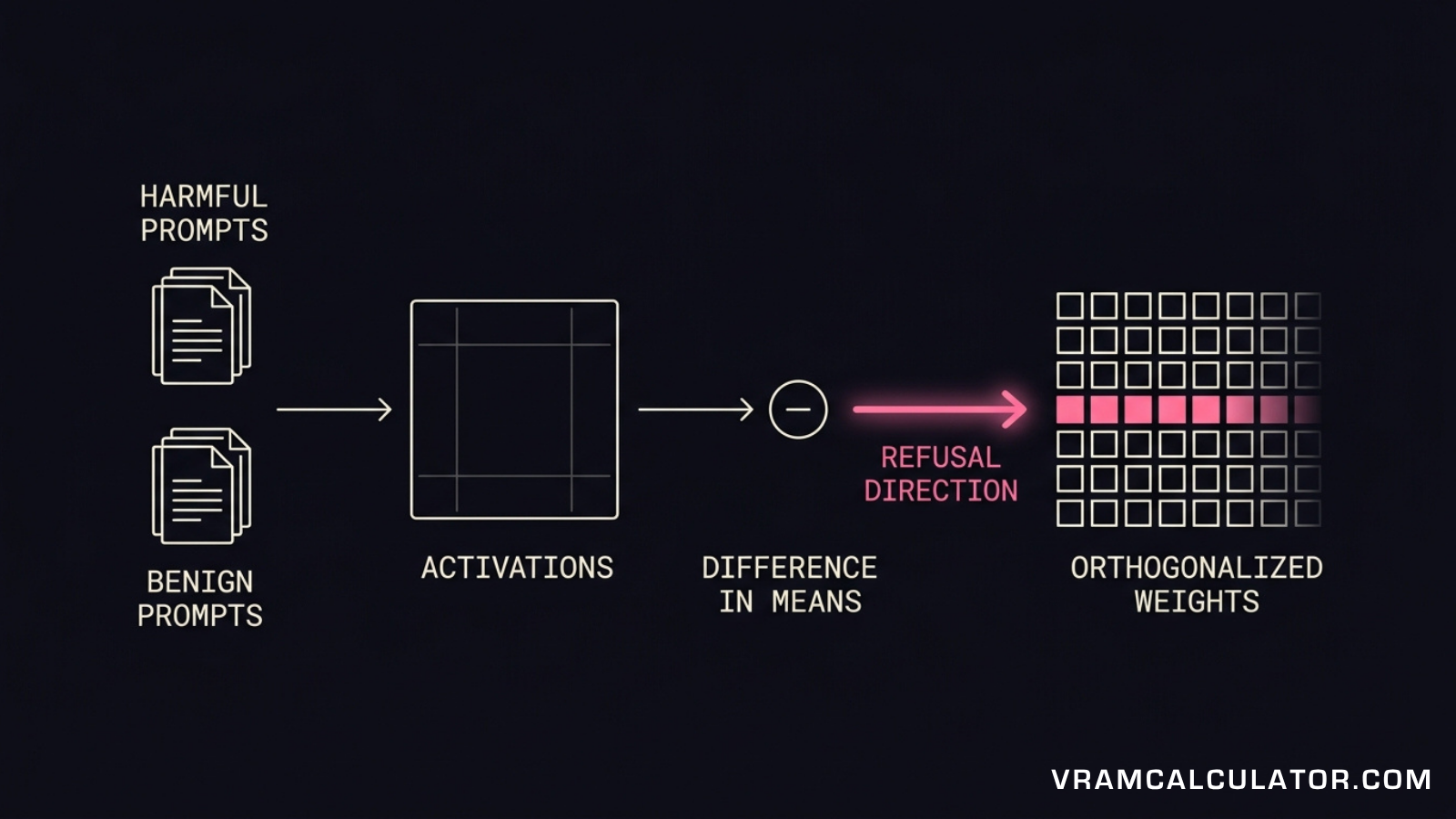
The mechanism, per the Arditi et al. paper and Labonne’s walkthrough, has four steps.
- Run a set of harmful prompts and a matched set of benign prompts through the model, capturing the activations inside every layer.
- Compute the difference-in-means between the two activation sets. That difference is a candidate refusal direction.
- Validate it: suppressing the direction should make refused prompts succeed, and amplifying it should induce refusals on harmless ones.
- Orthogonalize the weight matrices against the chosen direction, so the network can never project onto it again. Save the modified weights.
Two properties make this different from every older jailbreak. It is permanent, baked into the file you download rather than into a prompt you paste. And it is surgical: the paper’s own framing is “surgically disables refusal with minimal effect on other capabilities,” because the rest of the network is untouched.
The honest costs, which the abliteration guides themselves report: the surgery can leave a model slightly more repetitive or eager to please, and downstream benchmark scores usually drift a little. You are editing a safety behavior by removing a direction that safety training used; the base model’s other quirks come along for the ride. Abliterators re-run the process on each new base release, which is why every popular open model reappears abliterated within days of shipping.
Abliterated vs Uncensored: The Difference That Matters
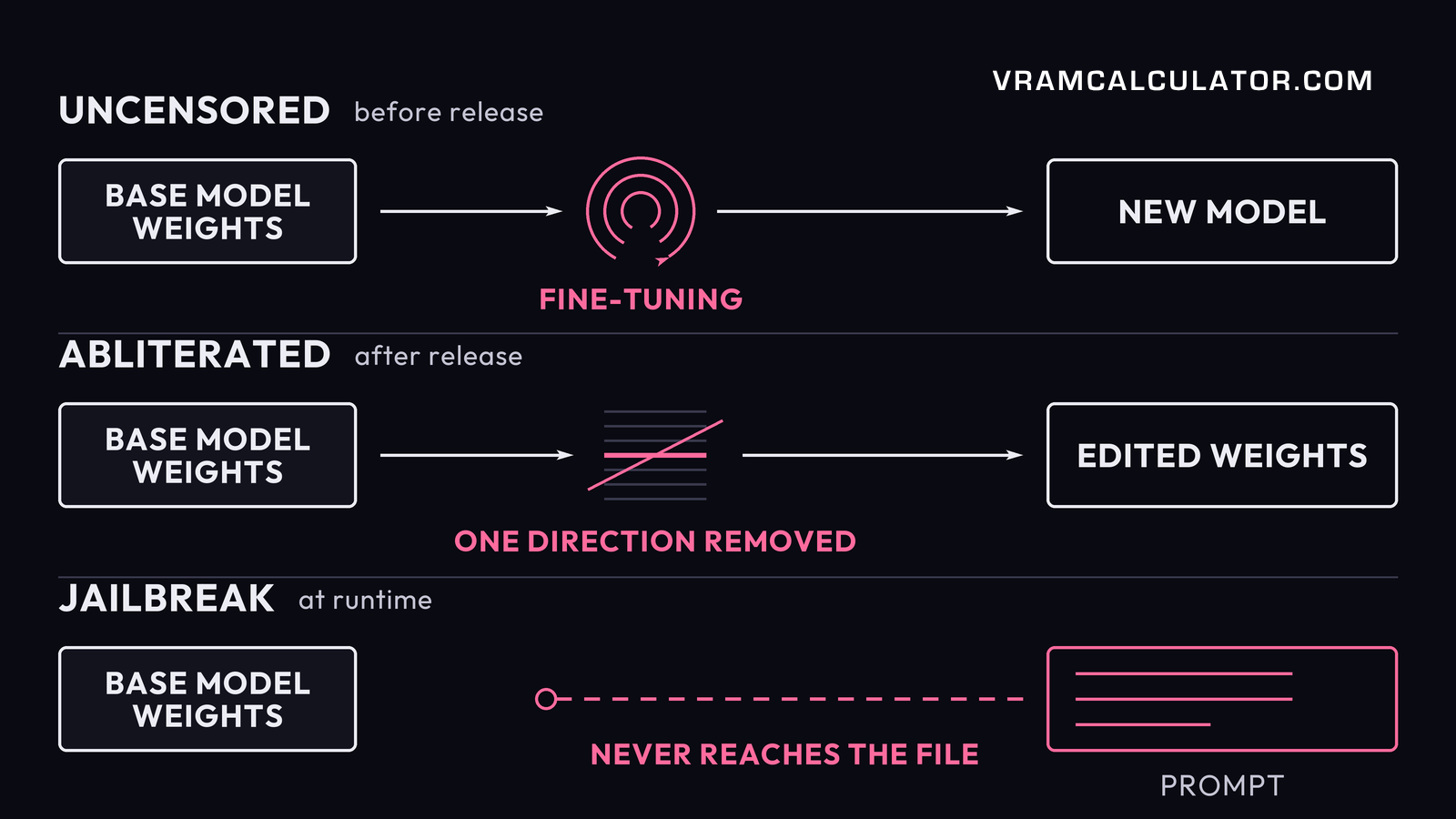
“Uncensored” describes how a model was trained. “Abliterated” describes how its weights were edited after training. The distinction sounds academic until you look at what each one actually is.
| Uncensored model | Abliterated model | |
|---|---|---|
| Where it happens | Fine-tuning, before release | Weight surgery, after release |
| Method | Continued training on compliant data, e.g. the dolphin recipe | Removing the refusal direction from the weights |
| What it needs | Training data, GPU hours, a training rig | Activation capture and one edited export; hours, not weeks |
| Base model | Often trained from an open base by a third party | Any open-weight model, including brand-new releases |
| Side effects | Capabilities shaped by the fine-tune data | Minimal by design; refusal is removed, the rest mostly kept |
| Who makes them | Fine-tune labs and community trainers | Community operators like huihui-ai, mlabonne, Blackfrost, 0bserverx |
A third category exists: jailbreaks, which are prompt-level tricks against an unmodified model. They are temporary, model-specific, and irrelevant to VRAM math because the file never changes.
Neither an uncensored fine-tune nor an abliterated edit transfers responsibility away from the person running it. The base model’s license still applies to derived weights in most cases, and every use that would be illegal with the base model stays illegal with the modified one.
Abliterated Models on Hugging Face: What You Actually Find
Search Hugging Face for “abliterated” and the scale surprises people who assume this is a fringe hobby. As of mid-August 2026, the download counts tell their own story:
| Abliterated release | Downloads |
|---|---|
| Qwen3.6-35B-A3B-abliterated-v4 (Bahushruth) | 1,170,000+ |
| gemma-4-31B-it-abliterated (wangzhang) | 820,000+ |
| Qwen3-30B-A3B-abliterated (mlabonne) | 450,000+ |
| Huihui-DeepSeek-V4-Flash-abliterated GGUF | 330,000+ |
| Qwen3.8-27B-Uncensored GGUF (JonathanColetti) | 180,000+ |
| Qwen3.8-27B-Heretic-Abliterated-Uncensored (0bserverx) | 81,000+ |
Qwen3.8-27B is the current case study. The base model shipped on 14 August 2026, and within the week the community had produced Heretic abliterations, BF16 and NVFP4 rebuilds, AWQ and GGUF quants, and MTP-enabled variants, from at least five independent publishers. The pattern repeats for every meaningful release: a lab ships weights, the abliteration operators ship their edits, and the quantizers ship the run files.
Naming conventions you will meet: the plain -abliterated suffix, -abliterated-v2 and higher for re-tuned attempts, OBLITERATED in caps for full-strength edits, Heretic for a popular automated recipe, and i1 prefixes marking imatrix-calibrated GGUF quants. The org huihui-ai functions as a near-industrial abliteration pipeline, with variants of Qwen, Gemma, and DeepSeek families.
One property matters for your disk and your GPU: abliteration does not change the architecture or the parameter count, so every VRAM figure in our calculator for a base model applies directly to its abliterated twin. We checked that rather than assuming it, and the check is in the next section.
Why Anyone Cares This Month: Watermarks Went Live
On 2 August 2026, Article 50 of the EU AI Act took effect, requiring machine-readable marking of AI-generated content. Some 190 organizations, including Google, Meta, Microsoft, Mistral, and OpenAI, signed the accompanying voluntary code of practice in late July. On 12 August, Anthropic announced its compliance path: an invisible watermark woven into Claude’s generated text, applied worldwide, not only in Europe.
Here is the detail that made writers look up from their keyboards. The watermark travels with the text through copy and paste, and may survive editing. Anthropic’s own documentation notes the mark applies wherever Claude processes content, including proofreading and translation, and that detecting it signals the text “may have been processed by Claude,” not that Claude wrote it. In practice: paste your finished book into Claude, ask it to fix one comma, take the output back, and the returned text can carry the mark. A detector reading that file would see a Claude-processed book over a single comma. Anthropic’s documentation states that a detected mark is not proof of authorship, and that heavy editing or very short passages can evade detection entirely. Both things are true at once: the net is wide, and the net has holes.
Critics of EU tech regulation read this as the familiar pattern, consent banners over cookies, verification loops over payments, and now fingerprints inside prose. Supporters answer that provenance is the price of trust in a flooded content market. What is verifiable either way is the direction: detection is moving into the model layer, and the models most people use are controlled by the companies that signed the code.
Open weights change the geometry of that sentence, but not completely. Google’s SynthID, which the company is pushing as an industry standard, is open-source and applies to open models too: Google’s own documentation shows it watermarking Gemma through a generation-time configuration, and The Star reports Google is pressing Apple, Nvidia, and OpenAI to adopt the standard. An open model can carry a watermark just as a closed one can.
And this is not a West-only story. Chinese models ship from labs operating under their own state’s rules: the Cyberspace Administration of China’s Measures for Labeling AI-Generated Content, with the mandatory national standard GB 45438-2025, took effect on 1 September 2025, eleven months before the EU’s Article 50 applied. Qwen, DeepSeek, and Kimi weights leave labs that hold CAC licenses and live under Chinese content rules, the same way Claude and GPT live under the EU code and American export politics. Two regulatory blocs, the same instinct: mark the content, control the pipeline.
That symmetry is why this site covers both ecosystems with the same math and no favorites. When a Qwen release and a Western release both land in the same week, both get measured from their own config.json, and neither gets a pass.
What open weights uniquely offer is the ability to inspect, verify, and modify, which closed APIs never grant. The open-weights race itself is not charity: Anthropic’s public position argues for keeping advanced chips out of rival hands, while NVIDIA and Meta lobby for open weights as American strategy. Control is a stated goal on all sides.
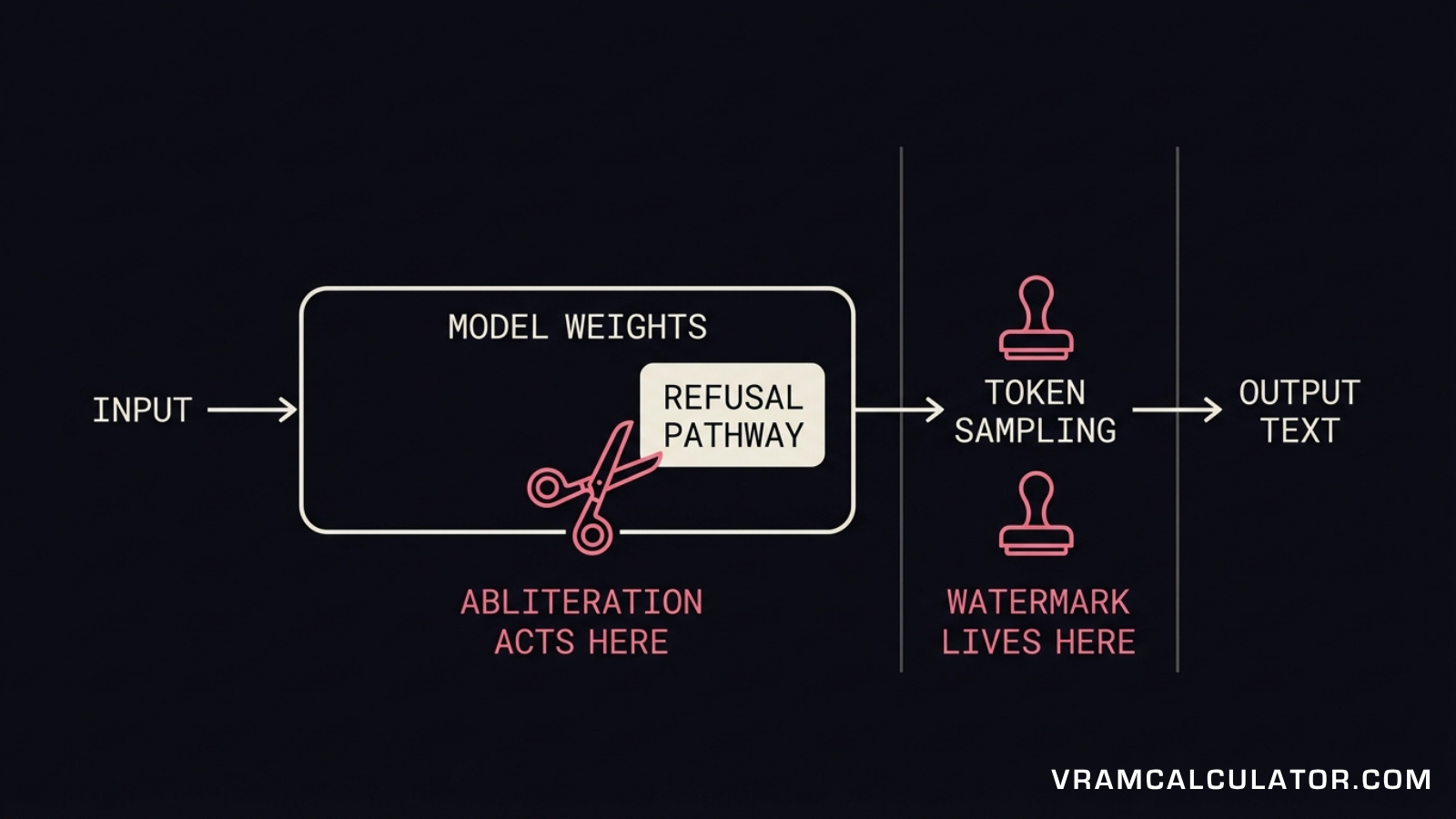
That is the context in which abliterated models sit. They do not make a model immune to regulation, surveillance, or watermarking, and they do not remove watermarks, which live in the generation step rather than the refusal pathway. What they represent is the one layer an individual user controls: weights on your own disk, editable, auditable, runnable offline.
How Much VRAM Do Abliterated Models Need?
Exactly what the base model needs. The surgery edits existing weights; it adds none. The table below comes from our own calculator, run at Q4_K_M, 32K context, F16 KV cache, llama.cpp overhead, the same settings every model page on this site uses. 32K is the context most people actually load, and it is where a 24 GB card starts to feel the difference between these models.
| Abliterated base | Q4_K_M weights | Total @ 32K | Hardware that fits |
|---|---|---|---|
| Qwen3.8 27B | 17.1 GB | 20.6 GB | 24 GB card (RTX 3090 / 4090) |
| Qwen3 30B-A3B | 18.2 GB | 22.6 GB | 24 GB card |
| Qwen3.6 35B-A3B | 21.2 GB | 23.1 GB | 24 GB card, just |
| Gemma 4 31B | 18.8 GB | 23.5 GB | 24 GB card, just |
| DeepSeek V4 Flash 0731 | 167.0 GB | 171.1 GB | datacenter tier |
The Qwen3.8 27B row is the current favorite and a useful worked example. Its abliterated builds download in the six figures, and the whole thing fits a used RTX 3090 with room to spare: 20.6 GB at 32K context, 18.9 GB if you only load 8K, and the abliterated variants change nothing about either number. Notice the ordering in the table: Qwen3.6 35B-A3B carries 2.4 GB more weight than Gemma 4 31B and still needs less total memory at 32K, because only ten of its forty layers hold a KV cache and the other thirty hold a fixed state. For smaller budgets the same logic scales down: 7B to 14B abliterated builds run on 8 to 12 GB cards, and the GPU checker lists every model your specific card holds.
We Checked the Files, Not the Claim
“Same size” is the kind of thing everyone repeats and nobody measures, so we
pulled the file sizes straight from the Hugging Face API on 16 August 2026 and
compared them.
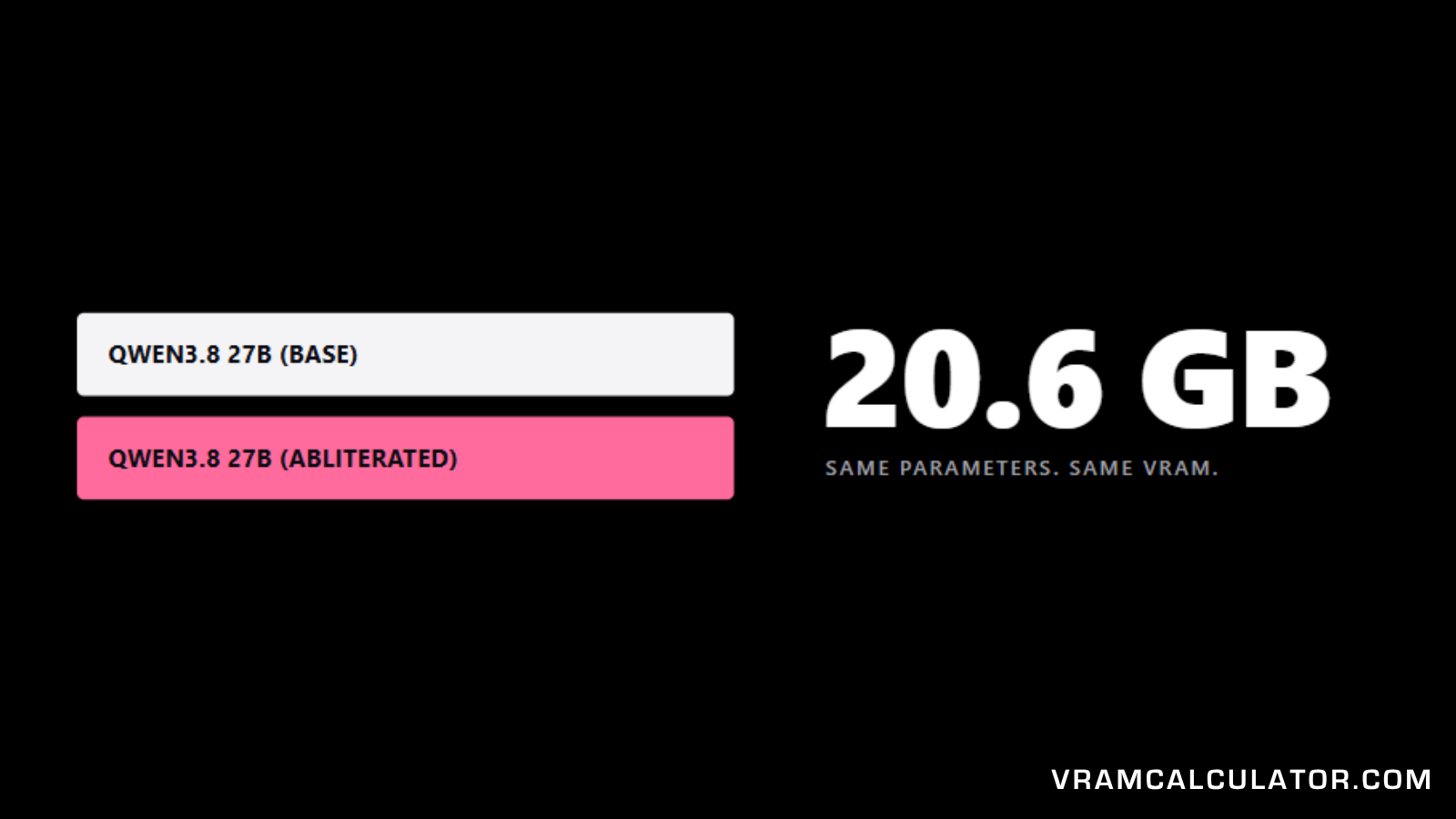
At full precision the abliterated build is the original, to the byte.
| Model | Base repo | Abliterated repo |
|---|---|---|
| Qwen3.8 27B | 55.56 GB, 18 shards | 55.56 GB, 18 shards |
| Gemma 4 31B | 62.55 GB, 2 files | 62.55 GB, 2 files |
| Qwen3 30B-A3B | 61.07 GB | 61.09 GB |
That is what the technique predicts. Orthogonalizing a matrix against a
direction changes the numbers inside it and not how many there are.
The GGUF quantizations are where people get confused, and the cause is not
abliteration. Different publishers quantize the same model to slightly
different sizes. For Qwen3.8 27B at Q4_K_M:
| Publisher | Q4_K_M | Type |
|---|---|---|
| lmstudio-community | 16.81 GB | base |
| unsloth | 17.11 GB | base |
| bartowski | 17.77 GB | base |
| ggml-org | 18.97 GB | base |
| 0bserverx | 16.55 GB | abliterated |
| Blackfrost-AI | 16.81 GB | abliterated |
The spread between two builds of the untouched base model is 2.16 GB. The
abliterated files sit inside that range, and Blackfrost’s abliterated Q4_K_M is
the same size as lmstudio’s base Q4_K_M to two decimal places. If you compare
one publisher’s abliterated GGUF against another publisher’s base GGUF, you are
measuring the quantizer, not the surgery.
The one real size difference we found had nothing to do with refusal at all.
Bahushruth’s Qwen3.6-35B-A3B abliterated v4 is 2.58 GB lighter than Qwen’s
release, and the index files say why: the base carries 1,045 tensors including a
27-block vision tower, the abliterated build carries 693 and not one vision
tensor. Its config declares Qwen3_5MoeForCausalLM where the original declaresQwen3_5MoeForConditionalGeneration.
That build is text only. It is a smaller download because the operator
dropped image input, not because anything was ablated. Check the tensor count or
the architecture string before you assume an abliterated repo is a drop-in
replacement for a multimodal base.
To run one, nothing exotic is needed: llama.cpp, Ollama, or LM Studio load the GGUF like any other model. If you are squeezing a 27B onto a 24 GB card with long context, quantizing the KV cache with -ctk/-ctv buys back several gigabytes, and our llama.cpp flags guide covers the exact levers. For the hardware itself, the best GPU for local LLM guide tracks the cards that make this class of model comfortable, including used-market picks. And for any model not in this table, the VRAM calculator computes the requirement from the model’s own architecture, with the same math that produced these numbers.
FAQ
What does abliterated model mean?
An abliterated model is an open-weight LLM whose refusal behavior was removed by deleting the refusal direction from its weights, instead of by retraining. The term combines “ablation” and “obliterated.” It answers prompts the base model would decline, keeps most other capabilities, and needs exactly the same VRAM as the original.
Is abliterated the same as uncensored?
No. Uncensored models are fine-tuned on compliant data before release, which shapes their capabilities through training. Abliterated models are edited after release by removing the refusal direction from the weights, a surgical change that leaves the rest of the network mostly intact. Both remove guardrails; they differ in method, cost, and side effects.
Are abliterated models on Hugging Face legal?
Modifying open weights is generally permitted under the base model’s license, and most abliterated releases state which license they inherit. The license’s use restrictions still apply to the modified weights, and legal responsibility for outputs stays with the user. Check the base license before commercial use, since some, like Gemma’s, carry use conditions.
Do abliterated models need more VRAM than the base model?
No. Abliteration edits existing weights and adds no parameters. We compared the published files in August 2026: Qwen3.8 27B is 55.56 GB across 18 shards in both the official repo and the abliterated one, and Gemma 4 31B is 62.55 GB in both. A Qwen3.8 27B abliterated build needs the same 20.6 GB at 32K context as the stock model. GGUF quantizations do vary by a few hundred megabytes, but that is the quantizer: four different publishers of the untouched base model span 16.81 to 18.97 GB at Q4_K_M, a wider range than any abliterated build sits outside.
Can abliterated models still refuse anything?
The refusal direction removal is not always total. Abliterators publish v2 or v3 re-tunes when the first pass leaves refusals, and some prompts, especially around genuinely restricted categories, can still trip residual behavior. The removal also does not disable an external filter, a runtime’s content layer, or an API provider’s rules.
Does abliteration remove AI watermarks?
No. Watermarks like Anthropic’s or Google’s SynthID operate in the generation or sampling step, not in the refusal pathway, so abliteration does not touch them by design. Anthropic’s own documentation notes heavy editing or very short text can defeat watermark detection, which is a separate mechanism. SynthID is open-source and applies to open models like Gemma, so open weights can carry watermarks just like closed ones.
Why do people abliterate models?
Stated reasons range from research into how refusal works, to avoiding false positives on legitimate prompts like medical or security questions, to the position that text generation on hardware you own should not carry a vendor’s policy layer. Since August 2026, EU content-marking rules and worldwide text watermarks have added another stated reason: keeping a verifiable editing layer under user control.
How do I run an abliterated model locally?
Download the GGUF from the model page, then load it in llama.cpp, Ollama, or LM Studio like any other model. Size it first with the VRAM calculator using the base model’s figures, since the requirement is identical. On tight cards, KV cache quantization flags recover several gigabytes at long context.