
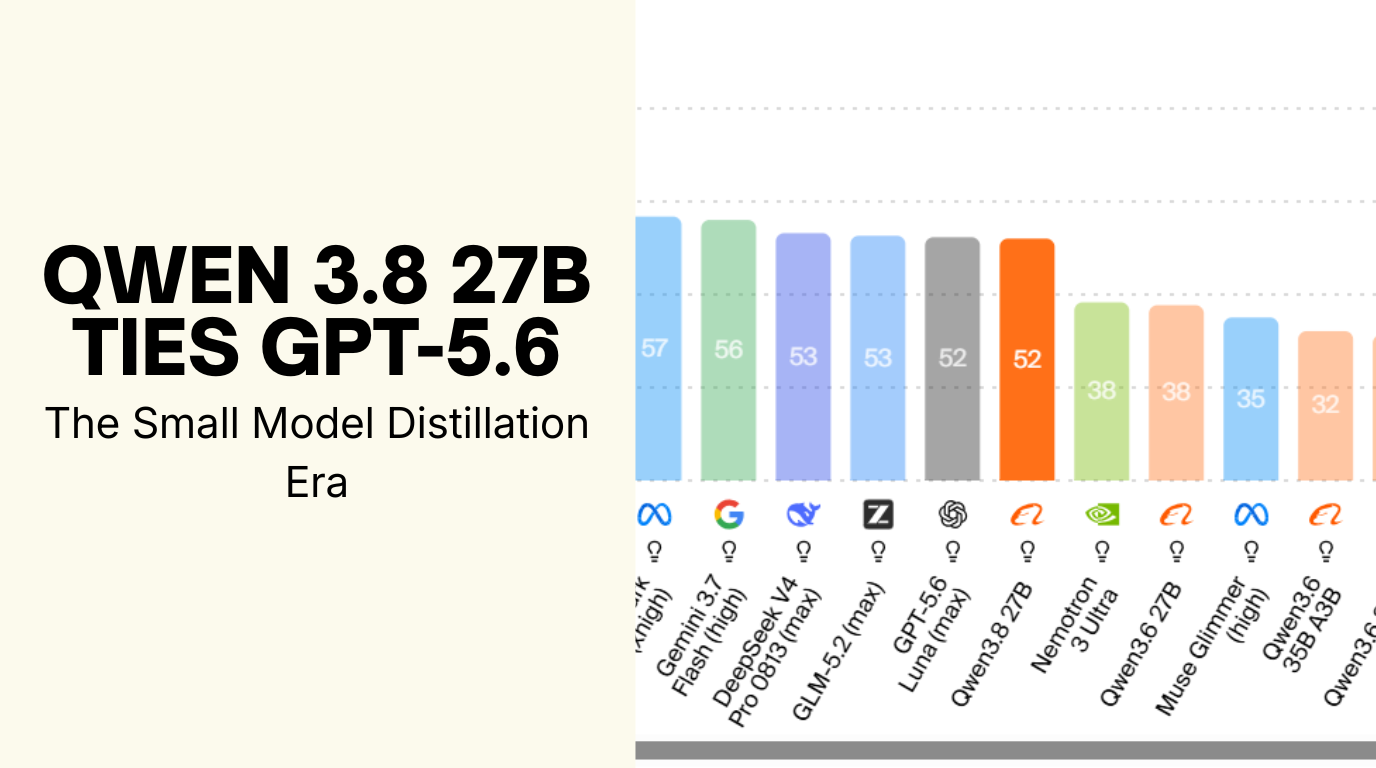
How Does a 27B Model Tie GPT-5.6?
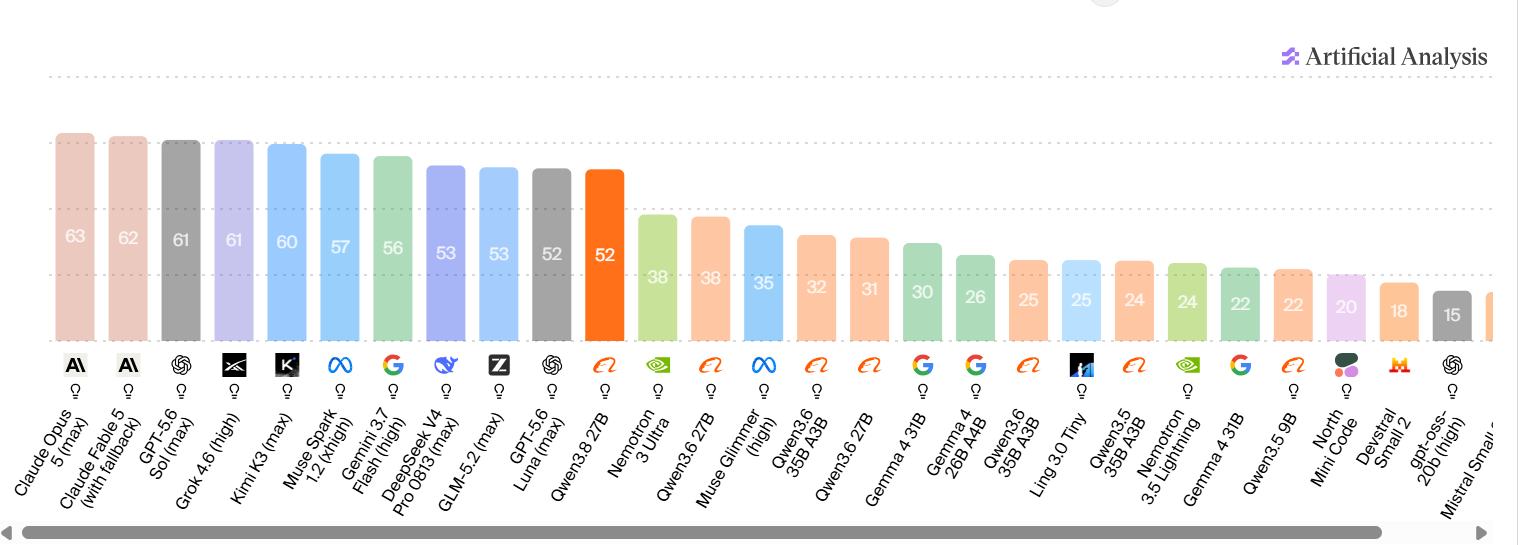
Qwen 3.8 27B scores 52 on the Artificial Analysis Intelligence Index, the same score as GPT-5.6 Luna (max), and one point behind GLM-5.2 at 753B and DeepSeek V4 Pro at 1.6T. The numbers come from Artificial Analysis, measured on their nine-eval index, and reported on 17 August 2026 by Simon Willison, who called it “a truly astonishing model.” A model that fits a used 24 GB graphics card now sits level with a frontier API on an independent benchmark. This page explains how that became possible: the architecture, the training pattern the whole industry now uses, and the community layer that took the same technique and ran with it in ways the labs never intended.
The short version is that intelligence split into two parts, and only one of them needs to live in the weights. Skill, the procedures for solving problems, compresses into small models through distillation. Knowledge, the facts a model carries in storage, does not compress and mostly does not need to, because an agent with tools and a 262K context can go get the fact instead of remembering it. Qwen 3.8 27B is what that split looks like when a lab executes it deliberately, and it is the strongest public argument yet that the small language model is the product category of this era rather than a budget compromise.
What the Score Actually Says
The Artificial Analysis Intelligence Index v4.1.1 blends nine evaluations: GDPval-AA v2, tau3-Banking, Terminal-Bench v2.1, SciCode, Humanity’s Last Exam, GPQA Diamond, CritPt, AA-Omniscience and AA-LCR. Qwen 3.8 27B tops the open-weight class from 4B to 40B, 135 models deep, and Artificial Analysis has it level with GPT-5.6 Luna (max), a closed model of undisclosed size. One caveat belongs next to every sentence in this section: the score is Artificial Analysis’s measurement, it has not been independently replicated elsewhere, and a benchmark tie is not a claim that the two models feel equivalent in daily use.
The pattern inside the score matters more than the headline. In Alibaba’s own comparison tables, the 27B beats its older sibling Qwen3.7-Plus on 10 of 12 rows and loses exactly two: GPQA Diamond and Humanity’s Last Exam. Against Claude Opus 4.6 Max, its clearest deficit is HLE, by 9.2 points. Those are the broad-knowledge evals, the ones that reward having stored a lot of the world. The rows it wins are coding, agentic tool use, and workplace tasks.
Every loss is the same kind of loss. That consistency is the strongest evidence available for what follows, because it is visible in published tables rather than asserted by anyone.
The Architecture: Built to Be Deployed, Not Just to Score
Strip the marketing and Qwen 3.8 27B is 27,781,427,952 parameters across 64 layers, and those layers are not the same kind. Sixteen layers use full attention and carry a KV cache. Forty-eight hold a fixed-size state that never grows with context, the same gated-delta-net design as the rest of the Qwen3.5 to 3.8 line. The KV heads number 4 with a head dimension of 256, native context is 262,144 tokens with no rope scaling, the vocabulary is 248,320 tokens, and multi-token-prediction tensors are trained directly into the weights.
The 48 fixed-state layers are the reason a 27B model holds 262K of context on a consumer card at all. A conventional dense 27B at that context drowns in its own cache; this one caches like a much smaller model because most of its layers stopped growing. That is a design choice about where the model would run, made before a single benchmark was attempted. Our calculator entry for the model shows the result: the full memory fit, at any context you pick, comes from those config values and nothing else.
Then there is the cost of the score, which the index’s own data exposes. Qwen 3.8 27B generated 160 million output tokens during evaluation, against a median of 43 million across the index. It is flagged as very verbose. Test-time compute substitutes for parameters: a smaller model thinking longer arrives where a bigger one arrives sooner. The honest comparison gives both numbers. Against the median it is 3.7 times more verbose. Against the model it actually ties, GPT-5.6 Luna at 130 million tokens, it is about 23 percent more. On an API that patience shows up as an invoice. Locally it is just decode time: your electricity works out to roughly $1.20 per million output tokens, and the conversion is on our speed page.
How 27B Got Frontier Skill: Distillation, the Pattern
No lab publishes its training recipe any more, and Alibaba has not stated how the 27B was trained. What follows is the mechanism the industry uses, visible in what the model does, and it is labelled as pattern rather than fact for this specific model.
The pattern is teacher-student distillation. Run a large model, the teacher, over a corpus of hard problems and capture not just its answers but its full reasoning traces, the chains of thought it walks on the way. Fine-tune a small model, the student, on those traces. The student does not learn the teacher’s knowledge, it learns the teacher’s procedures: how to decompose a problem, when to test a hypothesis, how to recover from a wrong step. Procedure is a few million tokens of behaviour. Knowledge is trillions of tokens of storage. The first fits in 27B. The second does not.
The public proof that this works at scale predates Qwen 3.8 by eighteen months. When DeepSeek released R1, they simultaneously published the DeepSeek-R1-Distill family, students from 1.5B to 70B distilled from the full model’s reasoning, and those students have been downloaded millions of times since: the 14B alone sits above 760,000 downloads, the 1.5B above 640,000. A distill lineage trained from a big teacher carried frontier-adjacent reasoning into files that run on a laptop. Every small model that scores like a big one since then is suspected of the same ancestry, and in most documented cases the suspicion is correct.
Add the two ingredients the benchmark tables already showed. Architecture that makes long reasoning affordable, so the model can afford to think. Test-time compute that trades tokens for parameters. A student distilled from a frontier teacher, deployed on deployment-friendly architecture, thinking for 160 million tokens, lands on 52. That is the whole trick, and none of it is magic. What no one outside Alibaba can confirm is the specific teacher. The 2.4T sibling in the same generation, Qwen3.8-2.4T-A95B, is the obvious candidate and the obvious guess, and it stays a guess: we can see what the model does, we cannot see how it was trained.
Qwen vs Claude: What the Tables Actually Show
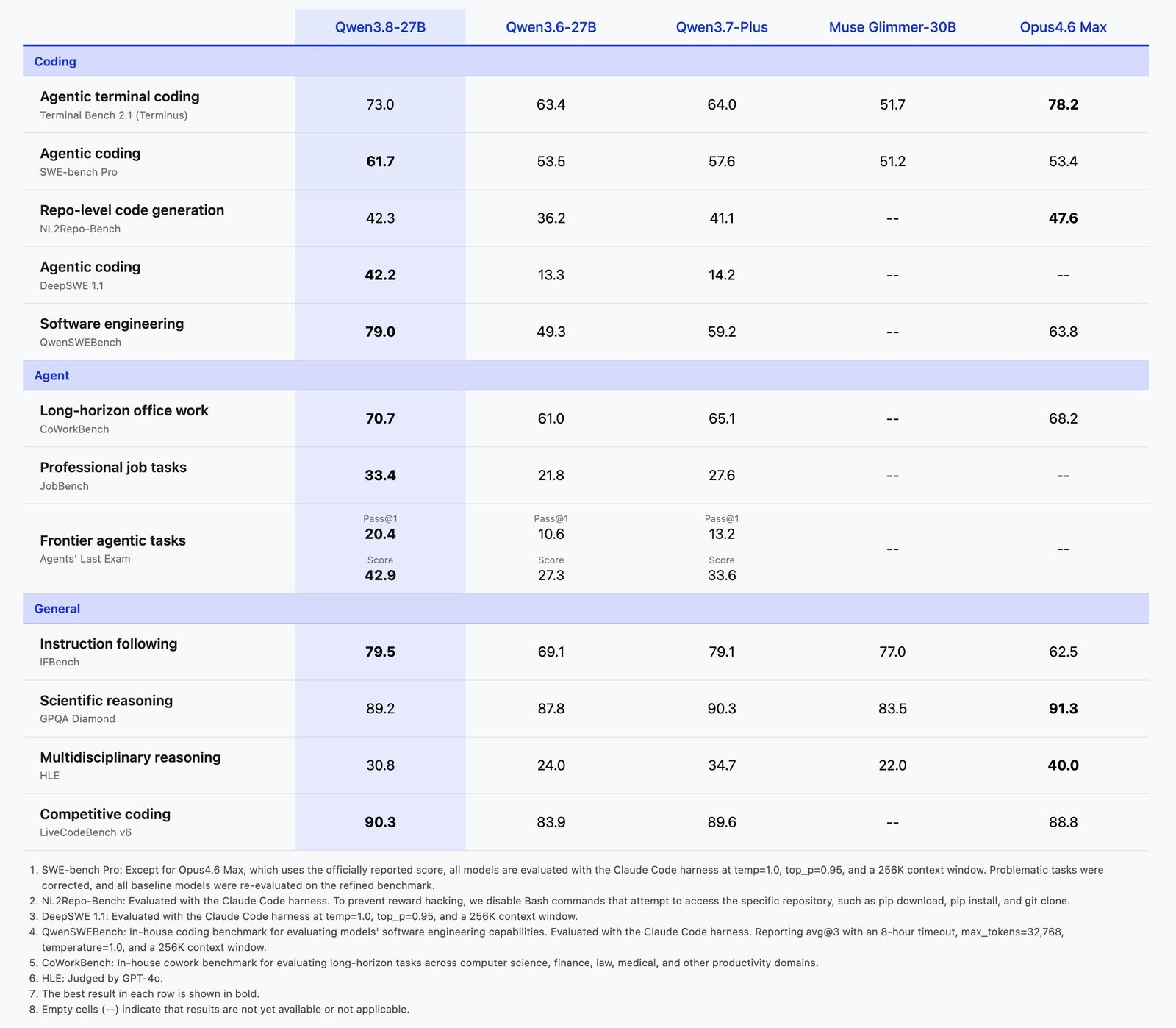
The comparison people search for is Qwen vs Claude, and the published rows give a sharper answer than the headline tie with GPT-5.6. Against Claude Opus 4.6 Max, in Alibaba’s launch tables, Qwen 3.8 27B leads the agentic rows, splits the coding rows, and loses the knowledge rows, with HLE the widest gap at 9.2 points. Those tables are vendor-published, which every launch table is, and Artificial Analysis’s independent index lands on the same shape.
Translated into use: for work where the model reasons over code, drives tools, and runs multi-step tasks with the facts supplied in context or fetched live, the 27B plays in the frontier’s league, at a fraction of the memory. For work where the model must already know obscure facts, cold, with no lookup, the bigger models still win, and the HLE gap is where it shows. Claude also carries the fuller ecosystem: the watermark regime, the enterprise tooling, the polish. What the 27B offers instead is the whole model, weights included, running on a card you can buy used for around $700.
The Wild Layer: Distillation as a Community Sport
Here the story leaves the labs. The technique above requires no secret: a teacher’s outputs, a student, and a GPU. On Hugging Face, searches for Claude-Opus-Distill, claude-distill and gpt-distill each return a full page of results. This is a layer now, not a handful of hobbyists, and it runs on a spectrum of transparency worth seeing in detail.
| Repo | Downloads | Declared base | What it is |
|---|---|---|---|
| deepseek-ai/DeepSeek-R1-Distill-Qwen-14B | 760,000+ | DeepSeek-R1 | the official proof, teacher named |
| Ma7ee7/Qwen3.8_4B_Distilled_GGUF | 184,000+ | Qwen3-4B-Thinking-2507 | a 4B carrying the Qwen3.8 name, base declared as a Qwen3 |
| TeichAI/gemma-4-31B-it-Claude-Opus-Distill | 90 | unsloth/gemma-4-31B-it | Gemma distilled on Claude Opus reasoning traces |
| thebbg/Ma7ee7-Qwen3.8_4B_Distilled-v2 | 31,000+ | none declared | a v2 re-quant of the above, no base |
| Ma7ee7/Qwen3.8_1.2B_LFM_Distillation_GGUF | 20,000+ | none declared | tagged for Liquid’s LFM line despite the Qwen name |
| Lord-H4D3ZS/Qwen3.8-Distill-35B-A3B-Coder-Abliterated | 8,000+ | Qwen3.6-35B-A3B | a distill, then abliterated, vision tower dropped |
Download counts are as of 18 August 2026 and move daily.
The TeichAI repo is the cleanest evidence in the whole field, because it declares everything: the base model, and four named datasets of Claude reasoning traces totalling roughly 4,300 examples. Four thousand traces is a rounding error against a pretraining corpus, yet it visibly moves how the model approaches problems. That is style transfer, procedure transfer, and it is the thesis of this page demonstrated in miniature: a few thousand examples of how to think change how a model thinks. They cannot change what it knows, and they do not try.
The verifiability spectrum is the spine of this layer. TeichAI names its base and every dataset. The 184,000-download Qwen3.8 4B declares a base of Qwen3-4B-Thinking-2507, a Qwen3 model, while its repository was created on 30 July 2026, two weeks before Qwen3.8 went public on 14 August. The fair caveat is real and cuts both ways: Hugging Face’s createdAt is repo creation, so a repo made in July and renamed later shows the same date. It does not change the substance on the page: the declared base is a Qwen3 4B, and the name on the tin is Qwen3.8. In a layer where anyone can relabel anything, the declared base is the only fact you came for, and most repos do not declare one.
Beyond distillation proper, the same community collects the other ingredients of frontier behaviour. Whole datasets of official system prompts, extracted and archived, circulate as libraries anyone can fine-tune against. Reasoning-trace datasets run to a million samples and more, the AM-DeepSeek-R1-Distilled set alone carrying 1.4 million. Every piece of a frontier model’s visible behaviour, its prompts, its traces, its refusal patterns, its answer style, is now training data someone has already packaged. The abliteration scene covered elsewhere on this site is the same impulse pointed at the guardrails instead of the skill.
The Hardware: Running the Student Yourself
None of the above is theory at the hardware level. Qwen 3.8 27B needs 20.6 GB at Q4_K_M with a 32K context, which fits a 24 GB card, and our VRAM requirements page breaks the fit down per quantization tier. On a used RTX 3090 it generates 41 to 63 tok/s, and the multi-token-prediction tensors trained into the weights roughly double that when the runtime flag is on: community A/B tables show 31.0 to 41.3 on a launch-day build, 50 to 70 on a mature one, and up to 144 tok/s on a 5090. Every number on the speed page is attributed to a named tester, because we benchmark no hardware ourselves.
The smaller distills drop the requirements through the floor. A 4B distilled student runs on 8 GB of VRAM at useful speed. The 1.2B variants run on a laptop. That is the actual endgame of the distillation era for a reader with a gaming PC: the frontier’s skill, at whatever memory tier you own, selected with the GPU checker and sized with the calculator.
FAQ
What is distillation in AI?
Distillation is training a small model, the student, on the outputs and reasoning traces of a large model, the teacher. The student learns the teacher’s problem-solving procedures rather than its stored knowledge. It is the standard technique behind small models that score like much larger ones, used openly by labs, including DeepSeek’s R1-Distill family, and by the community distillation scene on Hugging Face.
How did Qwen 3.8 27B get a frontier score at 27B?
Three stacked reasons, per the published evidence. Its architecture caches like a small model, with 48 of 64 layers holding a fixed state, so long reasoning is affordable. It spends heavily on test-time compute, generating 160 million tokens in evaluation against a 43 million median. And the industry-standard route to frontier skill at small size is distillation from a large teacher, which is the documented pattern across the field, though Alibaba has not confirmed the 27B’s specific training lineage.
Is Qwen 3.8 27B better than Claude?
On agentic and coding evaluations it competes with Claude Opus 4.6 Max, winning most of those rows in Alibaba’s launch tables. On broad-knowledge evaluations it loses, with Humanity’s Last Exam the widest gap at 9.2 points. Vendor tables and the independent Artificial Analysis index agree on the shape: frontier-level skill, sub-frontier-level stored knowledge. Which one is better depends entirely on whether your work supplies the facts.
Does distillation make a model worse?
It makes a model narrower. A distilled student inherits the teacher’s procedures and answer style at a fraction of the size, but not the teacher’s stored knowledge, so it loses on broad-knowledge evals and on obscure facts asked cold. On the procedures it was distilled for, coding, agentic tool use, structured tasks, the loss is small, which is why 4,300 reasoning traces can visibly change how a model approaches problems.
Can a small model really match a frontier model?
On benchmark indices, it now demonstrably can: Qwen 3.8 27B ties GPT-5.6 Luna at 52 on the Artificial Analysis Intelligence Index, measured independently by Artificial Analysis. The caveats are real: the score has not been replicated elsewhere, the small model spent 160 million tokens getting there, and a benchmark tie is not a claim of equivalence in daily use.
What hardware do I need to run Qwen 3.8 27B?
A 24 GB card. The model needs 20.6 GB at Q4_K_M with a 32K context, so an RTX 3090 or 4090 holds it with room, generating 41 to 63 tok/s on a 3090, roughly doubling with multi-token prediction enabled. Distilled 4B and 1.2B students run on 8 GB cards and laptops respectively.
What is the difference between a distilled model and a fine-tuned model?
Distillation is a kind of fine-tuning with a specific teacher: the training data is a larger model’s outputs and reasoning traces, and the goal is transferring its procedures. A general fine-tune uses any dataset toward any goal, a medical corpus, a chat format, a style. Every distilled model is fine-tuned; almost no fine-tune is a distillation.