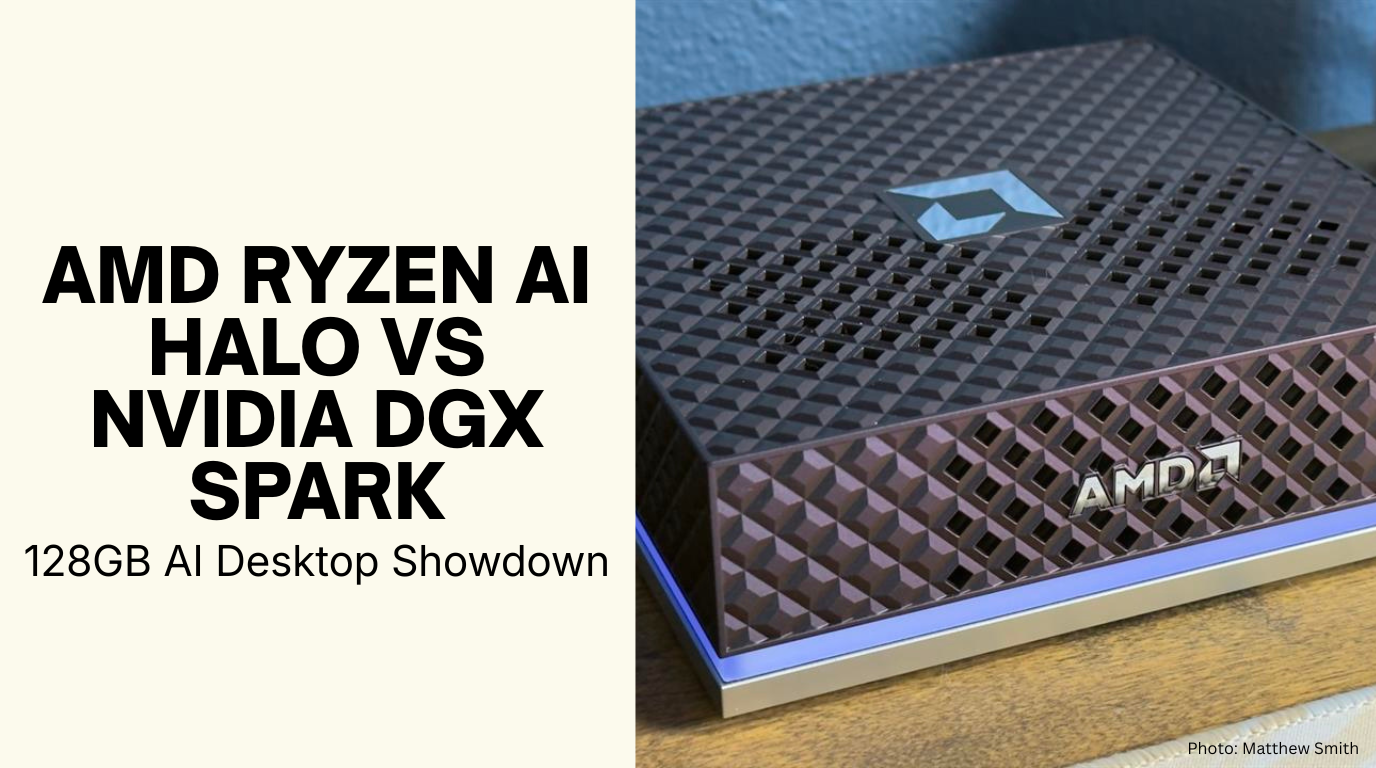
AMD Ryzen AI Halo vs NVIDIA DGX Spark: The 128GB AI Desktop Showdown
Which is better for local AI: the AMD Ryzen AI Halo or NVIDIA DGX Spark?
The NVIDIA DGX Spark is better for pure AI inference workloads, delivering 2.7× to 13.4× higher token throughput than the AMD Ryzen AI Halo thanks to hardware FP4 tensor cores and 200GbE clustering. The AMD Ryzen AI Halo at $3,999 is better as a daily-driver workstation: it runs Windows 11 natively, wins decisively in CPU tasks like compilation and rendering, and still fits 120B+ parameter models in its 128GB of unified memory. Choose the Spark if AI inference is the job; choose the Halo if AI is one of several jobs.
Both machines pack 128GB of unified memory into compact ~1.1 to 1.2 liter chassis. The similarity ends there. Here is the complete breakdown.
Head-to-Head Specification Comparison
| Specification | AMD Ryzen AI Halo | NVIDIA DGX Spark |
|---|---|---|
| Price (July 2026) | $3,999 (2TB SSD config) | $4,699 Founders Edition (~$4,000 OEM variants) |
| Processor | Ryzen AI Max+ 395, 16-core Zen 5 (x86) | GB10 Grace Blackwell, 20-core Arm CPU |
| GPU | Radeon 8060S integrated | Blackwell architecture, 5th-gen Tensor Cores |
| Unified Memory | 128GB LPDDR5x-8000 | 128GB LPDDR5X |
| Memory Bandwidth | 256 GB/s | 273 GB/s |
| FP4 Hardware Acceleration | ❌ No | ✅ Yes: up to 1 petaFLOP sparse |
| Operating System | Windows 11 + Linux dual-boot | DGX OS (Linux only) |
| Storage | M.2 2280 slot: upgradeable to 8TB | M.2 2242: restrictive, external NVMe-oF for heavy I/O |
| Networking | 10GbE | Dual 200GbE QSFP56 (ConnectX-7 SmartNIC) |
| Multi-Node Clustering | ❌ Not supported | ✅ Two units = 256GB for 405B models |
| Power Draw (GPT-OSS 20B inference) | ~102W | ~46W |
| Availability | Micro Center exclusive (US), launched July 10, 2026 | Broad availability, launched late 2025 |
Inference Benchmarks: The Numbers That Matter
Both systems load 200B parameter models locally. Throughput is where they diverge, dramatically.
| Benchmark | DGX Spark | Ryzen AI Halo | Spark Advantage |
|---|---|---|---|
| Llama 3.1 8B FP4 (128 concurrency) | 924.1 tok/s | n/a | n/a |
| Llama 3.1 8B (batch 64, equal ISL/OSL) | 3,573 tok/s | 267 tok/s | 13.4× |
| Qwen3 Coder 30B A3B FP8 (batch 64) | 482.6 tok/s | n/a | n/a |
| Qwen3 Coder 30B (prefill-heavy) | 1,663 tok/s | ~408 tok/s | 4.1× |
| GPT-OSS 120B FP4 (64 concurrency) | 162.7 tok/s | n/a | n/a |
| GPT-OSS 120B (prefill-heavy) | 2,760 tok/s | ~427 tok/s | 6.5× |
Why the gap is this large: Two architectural factors compound. First, the Spark’s 5th-generation Tensor Cores execute FP4 operations in hardware: the Halo has no FP4 acceleration and must run higher-precision math on its integrated Radeon 8060S. Second, prompt processing (prefill) is compute-intensive, and the Spark’s Blackwell GPU architecture is purpose-built for exactly this workload. The Halo’s memory bandwidth (256 GB/s vs 273 GB/s) is nearly equivalent: the bottleneck is compute, not memory.
The single-user reality check: These benchmarks measure batch and concurrent workloads. For single-user interactive chat, the gap narrows considerably. Community benchmarks on the Halo show Qwen3.6 35B at 8-bit running at approximately 60 tokens per second, and Qwen3.6 27B at 20 to 25 tokens per second, both comfortably above reading speed. DeepSeek V4 Flash runs on the 128GB Halo at ~200 TPS prompt processing and ~15 TPS generation. For a solo developer chatting with a model, the Halo is genuinely usable. For serving multiple users, batch generation, or agentic pipelines making parallel calls, the Spark’s advantage is decisive.
What the AMD Ryzen AI Halo Does Better
It’s a Real Computer
The Halo’s defining advantage is that it runs Windows 11 natively with Linux dual-boot support. This is not a footnote: it’s the entire value proposition. The Spark is locked to DGX OS, a Linux-only environment purpose-built for AI workloads. The Halo is a primary workstation that happens to fit 120B models in memory.
In CPU-bound benchmarks, the 16-core Zen 5 processor decisively beats the Spark’s 20-core Arm CPU: 7-Zip compression, Geekbench, Cinebench R23, and code compilation all favor the x86 machine. If your day is 80% compilation, rendering, and productivity apps with 20% AI experimentation, the Halo matches your workload profile.
Storage Freedom
The Halo’s standard M.2 2280 slot accepts cheap aftermarket NVMe drives up to 8TB. The Spark’s compact M.2 2242 format restricts internal upgrades severely: users with heavy I/O requirements must run external NVMe-oF storage across the 200G fabric, adding cost and complexity.
Zero-Configuration Model Loading
AMD pre-tuned the Halo’s Variable Graphics Memory so that massive models load without manual memory allocation configuration. Download, load, run.
$700 Cheaper
At $3,999 versus $4,699 for the Spark Founders Edition, the Halo undercuts NVIDIA by $700, though OEM Grace Blackwell variants from ASUS narrow this gap to roughly parity at ~$4,000.
What the NVIDIA DGX Spark Does Better
Raw AI Throughput: By Multiples, Not Percentages
The benchmark table above is unambiguous. In prefill-heavy and batch scenarios, the Spark delivers 2.7× to 13.4× the Halo’s throughput. Hardware FP4 with up to 1 petaFLOP of sparse performance is a generational capability the Halo’s integrated GPU cannot answer.
Clustering to 256GB
The Spark’s dual 200GbE QSFP56 interfaces allow two units to be stacked via QSFP cables, combining 256GB of unified memory, enough to run 405-billion parameter models locally. The Halo’s 10GbE networking supports no equivalent multi-node capability. For teams that anticipate scaling beyond 128GB, this is a structural difference, not a spec-sheet detail.
Cloud Continuity
Workloads prototyped on the Spark migrate to H200/B200 cloud infrastructure without code changes : same CUDA, same NeMo, same TensorRT stack. For enterprise teams whose local prototyping feeds cloud production pipelines, this ecosystem continuity eliminates an entire class of porting friction.
Power Efficiency
On GPT-OSS 20B inference, the Spark draws approximately 46W against the Halo’s 102W : less than half the power for multiples of the throughput. For always-on inference appliances, the electricity delta compounds.
The Decision Framework
Buy the AMD Ryzen AI Halo if:
- You need one machine for everything: Windows productivity, development, content creation, AND local AI
- Your AI usage is single-user, interactive, and experimental
- You want cheap storage expansion and standard PC upgrade paths
- Your workflow depends on x86 applications that will never run on Arm/Linux
Buy the NVIDIA DGX Spark if:
- AI inference is the machine’s primary job
- You serve multiple users, run agentic pipelines, or batch-generate
- You may cluster to 256GB for 405B-class models
- Your local prototyping feeds CUDA cloud production
- Power efficiency matters for always-on deployment
The honest summary: These machines look identical on a spec sheet (128GB, compact chassis, similar price) and serve almost entirely different buyers. The Halo is a workstation with an AI hobby. The Spark is an AI appliance with no other hobbies.
For users deciding between these unified-memory systems and traditional discrete GPU builds, our complete GPU buying guide covers the full 2026 hardware landscape including the used RTX 3090 market and Apple Silicon alternatives.
Where Both Systems Fit in the 2026 Market
The 128GB unified memory desktop category now has three competitors: the Halo ($3,999), the Spark ($4,699), and Apple’s Mac Studio lineup, though Apple’s June 2026 restructuring capped new Mac Studio configurations at 96GB, removing it from the 128GB conversation entirely for new purchases.
Against discrete GPUs, both systems occupy the capacity-over-throughput position. A secondary-market RTX 5090 at $3,859 to $4,649 delivers far higher single-model throughput but caps at 32GB, locking out the 70B-at-Q8 and 120B model tiers both these systems handle natively. The calculus is straightforward: models above ~35B parameters at high precision require unified memory architectures or multi-GPU rigs at these price points.
To verify exactly which models fit in 128GB, or any other memory configuration, at your target quantization and context length, use the VRAM calculator.
Frequently Asked Questions
Can the AMD Ryzen AI Halo run 120B parameter models?
Yes. The Halo’s 128GB of unified memory loads models up to approximately 200B parameters at compressed quantization. Community benchmarks confirm GPT-OSS 120B running locally, along with DeepSeek V4 Flash at approximately 200 TPS prompt processing and 15 TPS generation. Generation speed at this scale is usable for single-user interactive work but significantly slower than the DGX Spark’s hardware-accelerated throughput.
Is the DGX Spark worth $700 more than the Ryzen AI Halo?
For dedicated AI workloads, yes. The Spark delivers 2.7× to 13.4× higher inference throughput, supports clustering two units to 256GB for 405B models, and draws less than half the power under load. For mixed-use workstations where AI is secondary to Windows productivity and development, the Halo’s flexibility justifies the savings: the Spark cannot run Windows at all.
Does the Ryzen AI Halo run Windows 11?
Yes : native Windows 11 support with Linux dual-boot is the Halo’s defining advantage. The NVIDIA DGX Spark is locked to DGX OS, a Linux-only environment, and cannot run Windows under any configuration.
Can you cluster two DGX Sparks together?
Yes. The DGX Spark’s dual 200GbE QSFP56 interfaces allow two units to be connected via QSFP cables, combining 256GB of unified memory. This configuration runs 405-billion parameter models locally. A two-unit kit is available at retail for $10,499.99. The AMD Ryzen AI Halo has no equivalent clustering capability: its networking is limited to 10GbE.
Where can I buy the AMD Ryzen AI Halo?
As of its July 10, 2026 launch, the Ryzen AI Halo is available exclusively through Micro Center in the United States, priced at $3,999 for the 2TB SSD configuration.
Which is faster for single-user local chat: Halo or Spark?
The Spark is faster in absolute terms, but the practical gap narrows for single-user interactive use. The Halo runs Qwen3.6 35B at approximately 60 tokens per second and 27B-class models at 20 to 25 tokens per second, both above comfortable reading speed. The Spark’s advantage compounds in batch processing, multi-user serving, prefill-heavy workloads, and agentic pipelines where its 2.7× to 13.4× throughput multiple becomes decisive.