VRAMCalculator.com
Can Your PC Run GLM 5.3 Flash with Maya?
Maya splits the layers between the cards, in proportion to each card's room for experts. Each card holds its own layers' weights and their share of the session state, and keeps the same reserve beside its expert pool; the last card also carries the draft layer; a prompt borrows the tail of each card's pool while it runs; the pools add up and the RAM tier is shared once. Expert counts are estimates.
| Build | System RAM it uses | Fixed parts | Left for experts | Verdict |
|---|
Closest measured setups
How this is calculated (0.4 alpha)
This is a first test build for Maya, the engine that runs GLM 5.3 Flash (a 321B model, about 18B active per token). It covers one card, several identical cards, mixed cards (a layer split across two cards of different sizes) and unified memory (an AMD Ryzen AI Max machine, whose GPU and CPU share one pool). The "what you need" reverse path is not in this build yet.
On a Ryzen AI Max, Maya sizes the memory two ways. On Linux it reads the memory free once the model's fixed parts are loaded, keeps 16 GB for the system and 1 GB in reserve, and gives the rest to the experts; the GPU share set in the BIOS does not limit it. On Windows the GPU's share (Variable Graphics Memory) works like a graphics card with 3 GB kept free, and the rest is system RAM, less 16 GB. We take the share as AMD's largest, 96 GB of 128 (three quarters of the memory); set lower, fewer experts sit on the GPU. The machines come from the same device list as our Strata calculator, each traced to AMD's pages. An APU runs alone and drafts with the MTP block.
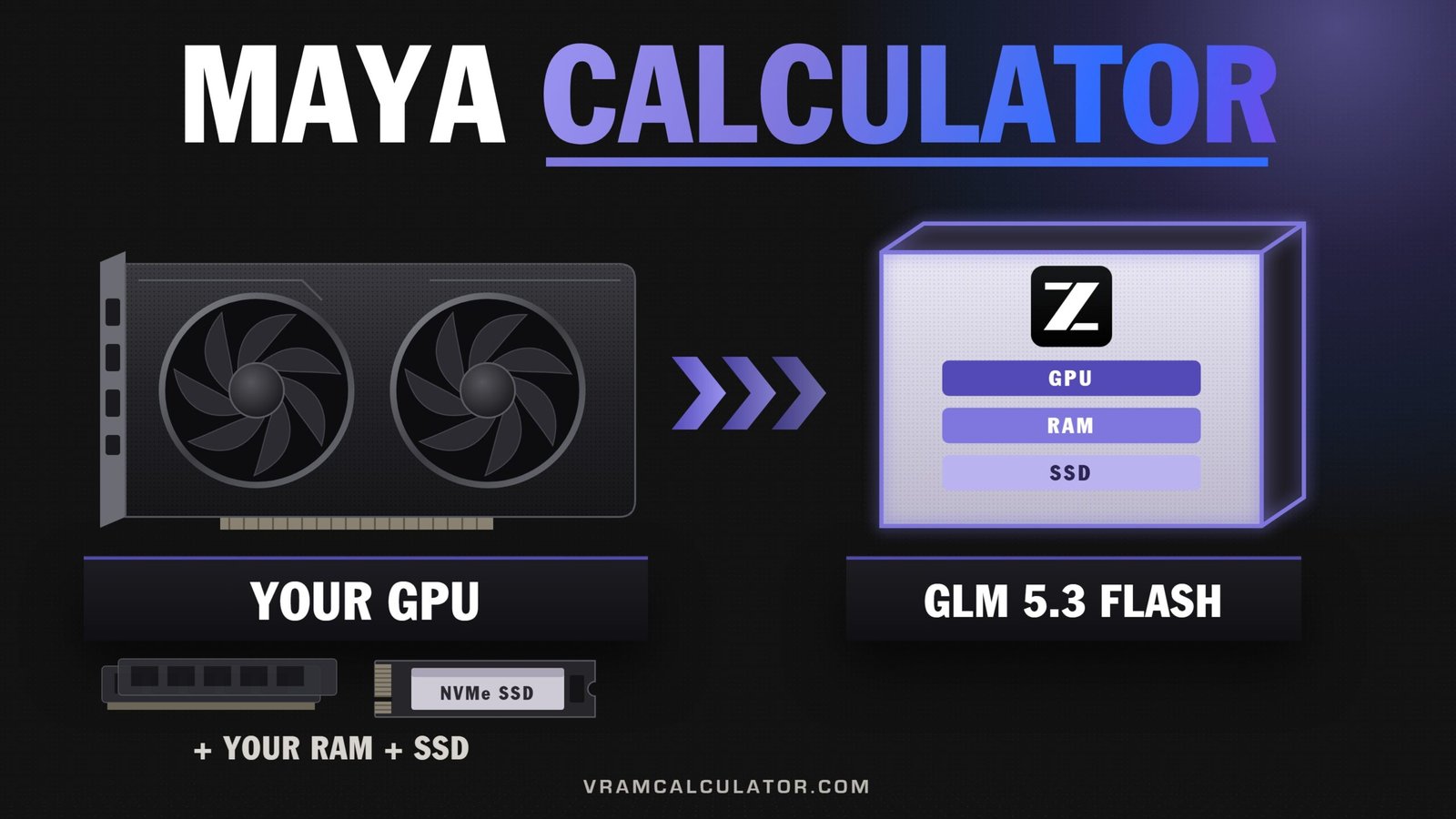
The arithmetic is ours, from GLM 5.3 Flash's own config and Maya's source, and Maya's published figures are the check. Maya keeps the experts a conversation uses most on the GPU, the next ones in pinned RAM, and the rest on an NVMe SSD; it pins all but about 6 GB of free RAM for its expert tier (16 GB on AMD, where Maya's setup also keeps 3 GB of the card free). The full-attention layers use MLA, so the KV cache is a 512-wide latent per token per full-attention layer, 11 of them, plus a small indexer cache: about 12.7 KB a token in FP16 and 7.4 KB in INT8, on top of a fixed state for the other 34 layers. On several cards each card holds only its own layers' weights and state. A card's expert pool is what is left once those, the driver, the CUDA context and a reserve (0.7 GB, 3 GB on AMD) are counted; a prompt borrows the pool's tail while it runs. We check the pools against the sizes Maya prints in its users' logs, and stay at or under every one.
Two choices from Maya 1.1.0 take VRAM from the expert cache when Maya starts. Requests at once (--parallel, 1 to 8): every extra request keeps its own session state on the cards, and each request keeps a snapshot of the 34 recurrent layers' state (0.14 GB). DFlash2 drafter (--draft dflash2, NVIDIA): 717 MB on the card with the model's head, plus a verify window and a copy of the recurrent state on every card, about 0.9 GB on one card in all; the MTP block is then not loaded. Maya's setup offers it on RTX 30 / A100 and newer. With more than one request at once Maya decodes without the drafter, which still holds its memory. Maya's setup can also download turboderp's EXL3 quants at 3.05 bits (125.3 GB) and, since Maya 1.1.9, at 4.05 bits (165.2 GB), both experimental and NVIDIA only. Their routed experts are 114.6 GB and 152.6 GB: the 4.05-bit build's are the largest of any build, Maya-L's included.
Pictures cost no VRAM between them: the image encoder starts only when a picture needs encoding, and while it runs it borrows the tail of the expert cache on the first card, which Maya takes back afterwards. A 448 px image is 256 tokens of context. AMD cards run text only, on one card or two (a Strix Halo APU alone).
Measured setups come from Maya's README, its GitHub issues and posts on X, each credited and linked. Speeds are measured only; the calculator places bytes, it does not predict speed.