VRAM calculator
VRAM Calculator for Local LLMs
Cards that hold it
How this is calculated
0x786f…1B09Domain for sale: voxllm.com
Your result
Read our measurements more often in Google: add VRAM Calculator as a preferred source.
Add vramcalculator.com on GoogleHow much VRAM do I need to run an LLM?
Three things, added together: the model's weights, the KV cache for your context, and what the inference engine keeps for itself. This VRAM calculator adds them for the model, quantization, context length and backend you pick above, and the default view shows how it lands: Qwen 3.8 27B at Q4_K_M with 32,768 tokens of context in llama.cpp needs 14.7 GB of weights on the card, 2.2 GB of KV cache and 0.5 GB of runtime, 17.3 GB in total. The smallest single card that holds it is a 20 GB one.
We test those totals on real cards. In our latest round, 33 setups on llama.cpp across 16, 24 and 96 GB cards, every setup the calculator called a fit ran, 27 of 27, and every estimate sat at or above what the card actually used. The VRAM calculator accuracy record lists every run, misses included.
- Weights are the model file. Where we have recorded a published GGUF file's size, the calculator uses that measured size instead of an estimate from the parameter count, because the two can differ by a lot at low bit widths. For every other model it multiplies parameters by bits per weight. llama.cpp keeps the token embedding table in system RAM unless the model ties it to the output, so on the card the weights come to a little less than the file.
- The KV cache is the memory that holds your conversation, and it grows with every token of context. It is usually what decides whether a card that fits the model also fits the chat. On Qwen 3.8 27B it is 0.7 GB at 8K, 2.2 GB at the 32K default and about 16 GB at the full 262K window.
- Runtime is what the engine keeps for itself: llama.cpp 0.3 GB plus 1% and 1 KB a token, measured on real cards with a prompt filling the context, Ollama 0.9 GB plus 3%, LM Studio 1 GB plus 3%, and vLLM 2.6 GB, with the whole total kept inside 90% of each card. ExLlamaV2 is not in the list: it loads EXL2 files, and the calculator sizes GGUF builds. A single card then keeps a fixed margin free, because filling one to the last megabyte fails in practice: 1.3 GB on a consumer card, where the desktop takes 1 to 1.5 GB at 1080p, and 0.5 GB on workstation and server cards.
Have a GGUF file already? Pick Custom architecture at the end of the model list, open the file in its GGUF reader, and it reads the model's header in your browser. Nothing uploads. It works as a GGUF VRAM calculator for files that are not in the list yet.
Start from the other side if you know your card and not your model: the GPU checker lists what your graphics card can run, the Mac checker does the same for Apple Silicon, and the speed checker estimates tokens per second once it fits.
Why our numbers are not a guess
Most VRAM calculators multiply the parameter count by a rule of thumb. Ours reads what the engine actually allocates. A popular rule of thumb budgets 31.8 GB of KV cache for Qwen 3.8 27B at 64K of context. llama.cpp allocates 4.2 GB. That rule is 7.5 times too high, enough to rule out a card that runs the model.
- Built from the engines’ own code. The Strata calculator and the Project Maya calculator port each engine’s own placement rules and are re-read at every release. The Strata calculator follows Strata 0.2.15 and lands within 2% of a real Strata run.
- Checked by people outside this site. A Radeon AI PRO R9700 owner’s Strata log showed 10,147 expert slots at 256K; our Strata calculator says 10,146. A Strix Halo tester’s startup logs from 18 November and our figures agree within 1%. When Unsloth published its memory table for Qwen 3.8 Flash Next, its 4-bit row said 112 GB; our calculator said 110.6 GiB.
- It models what simple calculators skip: experts kept in RAM or read from the SSD, two or more different cards, unified memory on Strix Halo, DGX Spark and Mac, the draft model’s memory, and speed checked against more than 800 measured runs.
- Outside figures are credited to the person who ran them, by name, with a link.
The tools are free, with no sign-in and no ads. The guide below is how we pay for the testing.
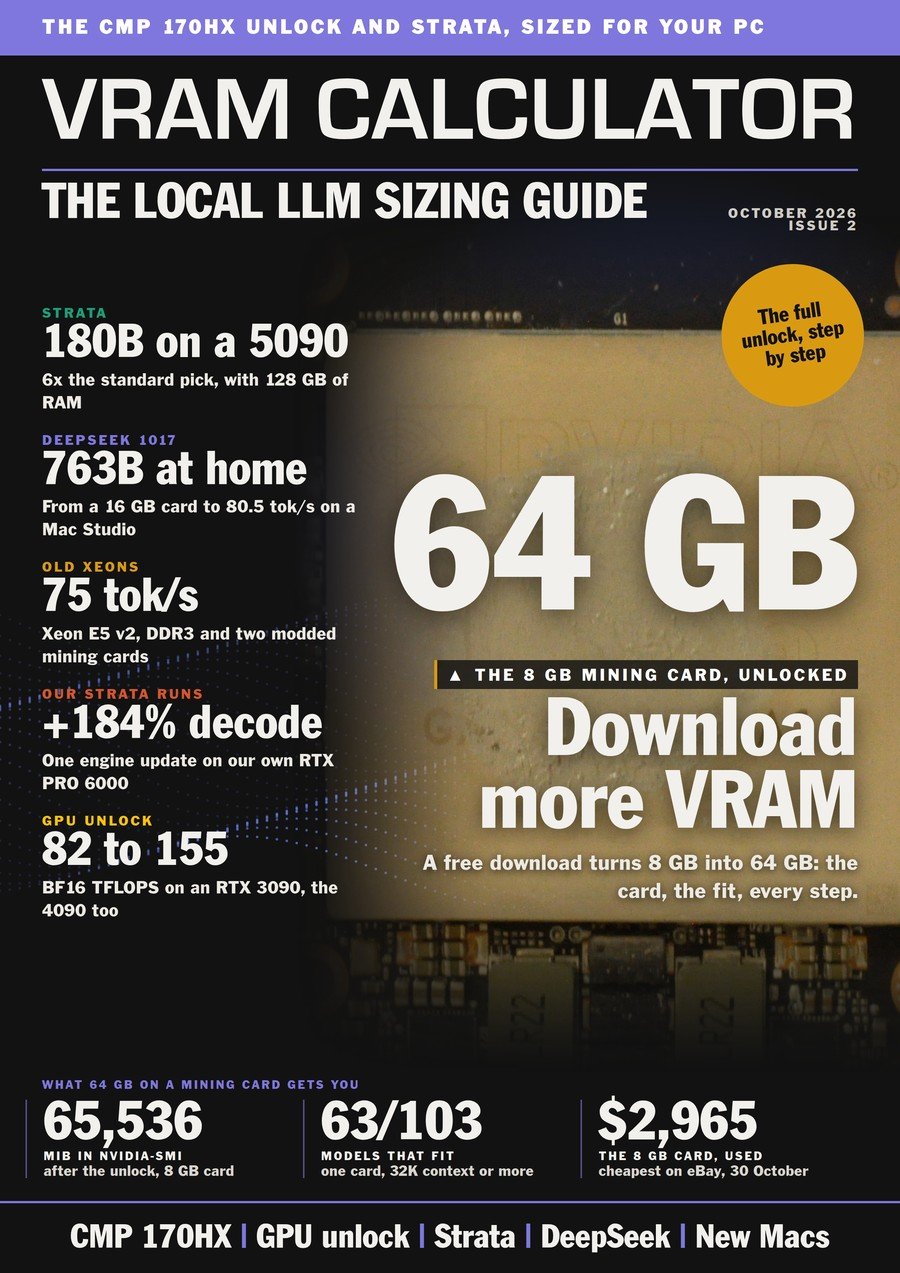
The Local LLM Sizing Guide. Issue 2, 31 October
That is one model on one card. Issue 2 sizes every model on every card, and finds 64 GB on a used mining card.
Every model sized for every tier from 8 GB to 128 GB, with the context each cache type holds. Plus the CMP 170HX unlock, step by step.
$24.90 for three issues, or $9 a month. Card or crypto.
FAQ
How do I calculate VRAM for an LLM?
Add the weights (the model file size, or parameters times bits per weight divided by 8), the KV cache for your context length, and the engine's overhead, then keep 1.3 GB spare on a consumer card, or 0.5 GB on a workstation or server card. This LLM GPU memory calculator does all three and shows each part separately.
How much VRAM does a 27B model need?
It depends on the model's attention design, so pick yours above. Qwen 3.8 27B at Q4_K_M comes to 17.3 GB at the calculator's default 32K context in llama.cpp, using unsloth's 16.5 GB file, and the smallest single card that holds it is 20 GB. Cut the context to 8,192 tokens and it drops to 15.8 GB, or about 16.7 GB with bartowski's 17.4 GB file. On a 16 GB card the first clears by about 0.2 GB, which the calculator flags as tight, needing a headless card: workable with no screen attached, too close on one that also runs your display. Plan on 20 GB or 24 GB. Longer context raises it, because the KV cache grows with every token.
Does context length change how much VRAM I need?
Yes. The weights stay the same size, but the KV cache grows with every token you keep: on Qwen 3.8 27B it is 0.7 GB at 8K, 2.2 GB at 32K and about 16 GB at 262K, more than the 14.7 GB of weights on the card. Set the context window to the length you actually use before you trust the total.
How accurate is this VRAM calculator?
In our latest round of real runs, 33 setups on llama.cpp across 16, 24 and 96 GB cards, every setup it called a fit ran, 27 of 27, and 30 of the 31 that loaded came within 5% of the memory the card really used, never below it. Its misses were all on the safe side: it called a few setups too tight that squeezed in. The full table is in the VRAM calculator accuracy record.
Does this VRAM calculator upload my GGUF file?
No. The calculation runs in your browser, and the GGUF reader opens only the file's header on your machine, so the file never leaves it. There is no signup.